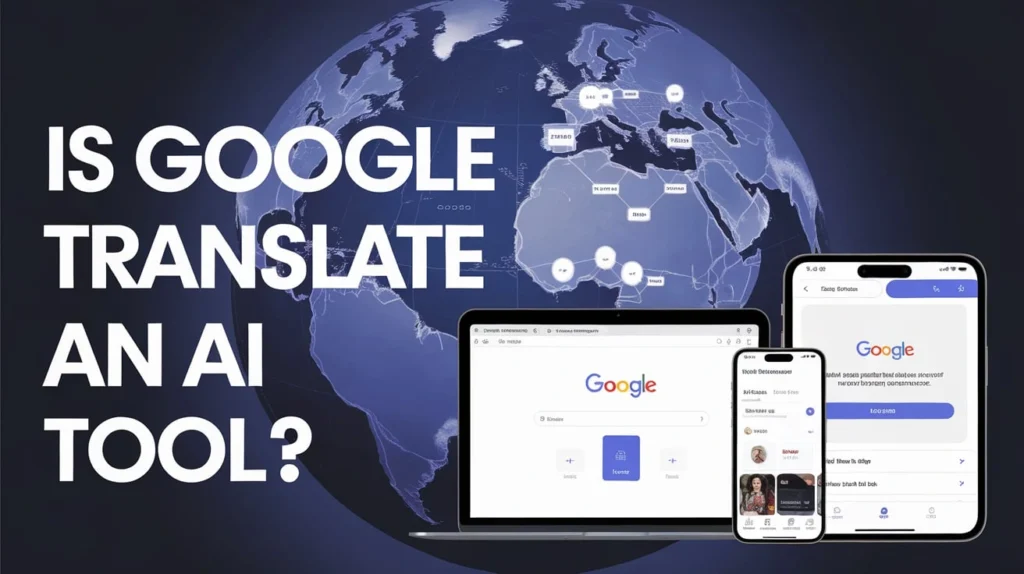
Is Google Translate an AI tool? This question comes up often, especially as artificial intelligence takes center stage in language learning, global business, and everyday communication. Many people use Google Translate daily, yet only a few understand the incredible technology behind it.
In this comprehensive guide, we break down exactly how Google Translate works, why it is considered an AI tool, and what makes it one of the most powerful language technologies ever created. This article blends expert insight with clear explanations to help you see Google Translate in a new light — not just as a simple translator, but as an advanced AI system driving global communication.
The Evolution of Google Translate: From Rules to Artificial Intelligence
When Google Translate launched in 2006, it used a rule-based method. Early versions relied on dictionaries and grammar rules created by humans. That approach was helpful but very limited.
Everything changed in 2016. Google introduced its Neural Machine Translation (NMT) system, which was powered by deep learning. This shift transformed Google Translate from a basic language converter into a true AI-driven tool.
From Statistical to Neural: How Google Transformed Translation
To understand why Google Translate is an AI tool, you need to know how translation systems evolved:
- Rule-Based Machine Translation (RBMT)
- Used human-built grammar rules
- Produced rigid and sometimes unnatural sentences
- Statistical Machine Translation (SMT)
- Analyzed huge text datasets
- Generated translations based on probability
- Improved accuracy but still struggled with context
- Neural Machine Translation (NMT)
- Uses artificial neural networks
- Learns patterns from massive multilingual data
- Produces fluid, human-like translations
According to Google AI research, NMT reduces translation errors by up to 60% compared to previous methods. That jump is possible only because of advanced AI technology.
What Makes Google Translate an AI Tool?
Google Translate qualifies as an AI tool because it uses deep learning, neural networks, and machine learning models to understand and generate language. These systems do far more than match words. They detect meaning, tone, grammar, and even cultural context.
Core AI Technologies Behind Google Translate
Here are the main AI components that power Google Translate:
Neural Networks
Neural networks mimic how the human brain processes information. Google’s neural models read whole sentences, grasp meaning, and produce context-aware translations.
Deep Learning
Deep learning allows models to learn patterns without being told what to look for. Over time, Google Translate becomes smarter because it learns from vast amounts of multilingual data.
Machine Learning
Machine learning enables the system to improve through feedback and correction. The more data it sees, the more accurate it becomes.
Natural Language Processing (NLP)
NLP helps Google Translate understand grammar, sentence structure, idioms, and even slang.
Multilingual Models
Google now uses a single AI model that can translate between more than 100 languages. According to Google’s research team, this multilingual approach makes translation more accurate because languages learn from each other.
All these technologies work together to make Google Translate one of the world’s most advanced AI language tools.
Why Google Translate Needs AI to Function Effectively
Language is messy, flexible, and full of nuance. Therefore, simple computer rules can’t capture everything humans express.
AI helps Google Translate:
- Understand context instead of translating word-for-word
- Choose the best translation from multiple possibilities
- Maintain tone and meaning across languages
- Learn from billions of sentences
- Improve accuracy with every update
Imagine trying to translate idioms like “spill the beans.” A rule-based translator might literally interpret it as falling legumes. An AI translator, however, learns patterns from millions of examples and understands it means “reveal a secret.”
Google Translate succeeds because AI allows it to think beyond literal text. Humans communicate in layers, and AI uncovers those layers.
How Google Translate Uses AI in Real Time
Google Translate doesn’t just translate text; it interprets meaning and adapts instantly. Here’s what happens behind the scenes when you type a sentence:
- The system breaks the sentence into units of meaning.
- NLP models evaluate grammar and structure.
- Neural networks predict the best translation based on learned patterns.
- The system restructures the output to sound natural in the target language.
- Machine learning updates the model with feedback over time.
All of this happens in fractions of a second.
Example: How AI Helps Translate Complex Sentences
Try translating the sentence:
“She ran out of time, even though she started early.”
A simple translator might mix up “ran out” or misplace “even though.” Google Translate uses context learned from millions of examples to produce accurate, fluent translations across dozens of languages.
This is one clear sign that Google Translate is an AI tool at its core.
Real-Life Scenarios: How AI in Google Translate Helps People
AI-powered translation affects our daily lives more than we realize. Here are a few examples:
Travelers
A tourist in Tokyo can point their phone at a menu, and Google Translate instantly overlays English text using AI-powered computer vision.
Students
Learners use Google Translate to understand academic papers or communicate with teachers from other countries.
Businesses
Companies rely on Google Translate to support multilingual customers, review global feedback, or collaborate with international partners.
Emergency Situations
During natural disasters, organizations use Google Translate to communicate quickly with affected communities.
In all these cases, AI is the force behind the tool’s speed and accuracy.
Strengths and Limitations of Google Translate as an AI Tool
Like any AI system, Google Translate has strengths and limitations. Understanding both helps you use it more effectively.
Strengths
- Fast and accessible for millions of users
- Supports more than 100 languages
- Translates whole sentences, not individual words
- Improves constantly through machine learning
- Includes voice, camera, and live conversation modes powered by AI
These strengths make it a reliable everyday translation tool.
Limitations
- Struggles with highly technical or poetic language
- May misinterpret cultural expressions
- Can produce errors in languages with limited training data
- Not a replacement for human translators in legal or clinical contexts
AI is powerful, but it isn’t perfect. Understanding these limits helps you decide when to rely on Google Translate and when to use professional translation services.
Is Google Translate Accurate? What Experts Say
According to multiple peer-reviewed studies published on Google Scholar and in journals like Machine Translation, neural machine translation significantly improves accuracy, especially for major languages.
However, experts note that accuracy varies:
- High-resource languages (English, Spanish, French) perform best.
- Low-resource languages (Somali, Hmong, Amharic) show larger variability.
Researchers also highlight that AI translation systems sometimes produce “hallucinations,” where the system confidently generates incorrect text. This is a known limitation of neural models across the industry.
Even so, Google Translate consistently ranks among the most accurate consumer translation tools available.
Google Translate vs. Human Translators: How AI Compares
AI translation has improved dramatically, but human translators still excel in areas where cultural nuance, creativity, or deep expertise matter. Here’s a comparison:
FeatureGoogle Translate (AI)Human TranslatorSpeedInstantSlowerCostFreeUsually paidContext understandingStrong, but not perfectExcellentCultural sensitivityInconsistentHighHandling technical documentsMixedVery strongCreative translationLimitedExcellent
For casual use, Google Translate is more than enough. For legal contracts, medical documents, or marketing copy, human translators remain the gold standard.
How Google Continues Improving Its AI Translation
Google invests heavily in AI research. Some recent advancements include:
Zero-Shot Translation
The system can translate between language pairs it has never directly trained on. For example, it can translate from Japanese to Hindi even if it learned these languages only through English.
Federated Learning
This method allows Google to improve translation models without accessing private user data directly. AI learns patterns while preserving privacy.
Multimodal Input
Google Translate can now combine text, audio, and image data for more accurate results.
These innovations show that Google Translate is not just an AI tool today — it’s becoming more intelligent over time.
When Should You Use Google Translate? Best Use Cases
Here are the best times to use Google Translate:
- Quick translations while traveling
- Understanding foreign websites and documents
- Learning vocabulary and simple sentence structures
- Communicating with people who speak different languages
- Getting the gist of ideas in another language
Google Translate is ideal for general understanding, not professional precision.
Tips for Getting Better Results with Google Translate
Because Google Translate is an AI tool, certain strategies help you get more accurate results:
1. Use simple, clear sentences
AI handles direct language better than complex or ambiguous text.
2. Avoid slang if possible
Slang and idioms vary widely, and translations may lose meaning.
3. Check alternate translations
Google often provides several options — choose the best one.
4. Use the “listen” feature
Hearing the translation helps confirm pronunciation and phrasing.
5. Learn more in our guide on multilingual content creation
This guide explains how to write English text that translates more accurately into other languages.
The clearer your input, the better the output.
Is Google Translate an AI Tool? Final Answer
By now, the answer is clear: Yes, Google Translate is an AI tool, and one of the most advanced language AI systems in the world. It uses neural networks, deep learning, NLP, and machine learning to deliver fast, accurate translations across more than 100 languages. Google Translate is not just a dictionary — it’s an evolving AI powered by years of research and billions of data points.
Conclusion: The Future of AI-Powered Translation
In today’s global world, tools like Google Translate help break down language barriers more smoothly than ever. The system will only grow more capable as AI advances. Whether you are a traveler, business owner, student, or curious learner, understanding how Google Translate works helps you use it more confidently.
So, is Google Translate an AI tool? Absolutely — and it’s shaping the future of communication one translation at a time.
FAQs About “Is Google Translate an AI Tool?”
1. Is Google Translate an AI tool or just a dictionary?
Google Translate is definitely an AI tool. It uses neural networks and machine learning, not basic word lists, to understand and translate full sentences.
2. How does Google Translate use AI?
It uses deep learning and NLP to analyze meaning, grammar, and context. These AI models help it produce more natural and accurate translations.
3. Is Google Translate better than other AI translators?
Google Translate is one of the most advanced systems available to the public. However, accuracy varies by language, and some tools like DeepL perform better for specific language pairs.
4. Can Google Translate replace human translators?
Not completely. It works well for basic communication, but humans are still more accurate in legal, medical, and creative fields. AI tools don’t always understand cultural nuance.
5. Will Google Translate become even smarter in the future?
Yes. Google continues to invest in AI research, including multimodal translation and zero-shot learning. The tool will improve as models grow more advanced.