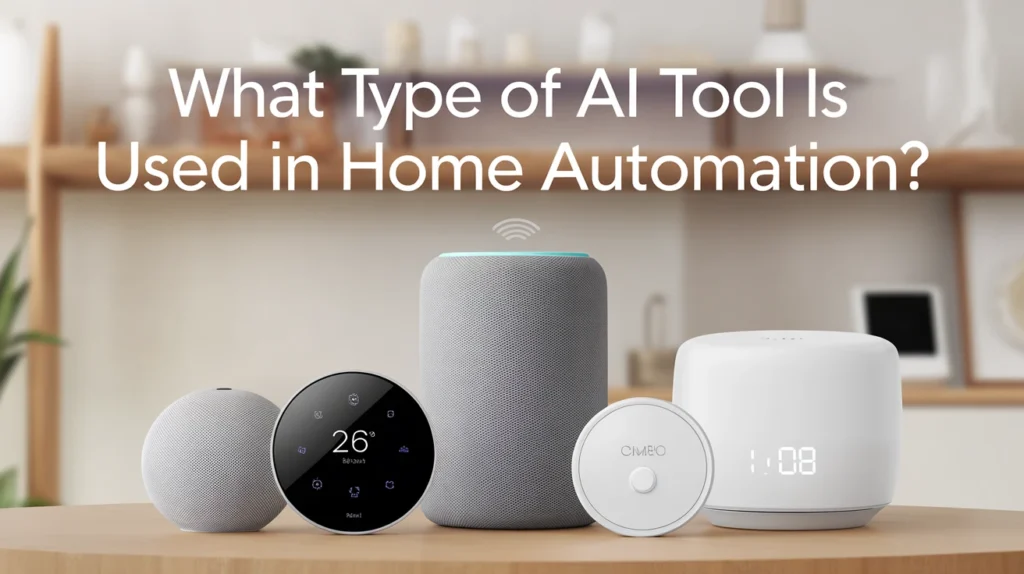
What type of AI tool is used in home automation is one of the most common questions homeowners ask as smart technology becomes part of everyday life. Lights that turn on by voice, thermostats that learn your schedule, and security cameras that recognize faces no longer sound futuristic. They are already here. However, many people still do not understand what kind of artificial intelligence powers these systems or how they truly work.
In this in-depth guide, you will discover the exact types of AI tools used in home automation, how each one functions, and why they matter. You will also explore real-life examples, benefits, risks, and how to choose the right AI-powered system for your smart home.
Understanding Home Automation in Simple Terms
Home automation refers to the use of technology to control household systems automatically. These systems include lighting, heating, cooling, security, entertainment, and appliances. Instead of manual control, devices respond to commands, schedules, or intelligent decisions.
However, basic automation only follows fixed rules. True smart homes rely on artificial intelligence. AI allows systems to learn from your behavior and adapt over time. Therefore, AI is the brain behind modern home automation.
Think of traditional automation like a remote-controlled toy. In contrast, AI-powered automation is like a self-driving car. It observes, learns, and makes decisions on its own.
What Type of AI Tool Is Used in Home Automation Systems?
To answer what type of AI tool is used in home automation clearly, it is important to understand that no single AI tool runs everything. Instead, a combination of AI technologies works together. Each tool handles a specific task such as voice control, vision, prediction, or decision-making.
The main types of AI tools used in home automation include:
- Machine Learning (ML) tools
- Voice Recognition and Natural Language Processing (NLP) tools
- Computer Vision tools
- Predictive Analytics tools
- Edge AI tools
- AI-powered IoT platforms
Each of these plays a distinct role. Together, they create a truly smart environment.
Machine Learning Tools in Home Automation
Machine learning is the most important AI technology in smart homes. It allows devices to learn from data without being manually programmed for every situation.
How Machine Learning Works in a Smart Home
Machine learning tools analyze patterns in your daily habits. For example, a smart thermostat records when you wake up, leave home, and return. Over time, it automatically adjusts temperatures to match your routine.
Therefore, instead of you setting schedules every day, the system learns for you.
Real-World Example
Google Nest Thermostat uses machine learning to reduce energy waste. According to Google’s official product documentation, Nest can lower heating costs by up to 15% by learning user behavior and automatically optimizing temperature settings.
Key Uses of Machine Learning in Home Automation
- Learning daily routines
- Optimizing energy usage
- Detecting unusual behavior
- Predicting maintenance needs
Without machine learning, smart homes would feel rigid and mechanical. With it, they feel intuitive and personal.
Natural Language Processing (NLP) Tools for Voice Control
Voice assistants are now a central part of home automation. These assistants depend on Natural Language Processing, or NLP.
What NLP Does in Smart Homes
NLP allows AI systems to understand and respond to human language. When you say, “Turn off the lights,” NLP converts that sentence into machine instructions.
It does not just hear words. It interprets meaning.
Popular NLP-Based Home Assistants
- Amazon Alexa
- Google Assistant
- Apple Siri
These voice assistants are powered by large language models and speech recognition engines.
Why NLP Is Critical for Home Automation
- Enables hands-free control
- Improves accessibility for elderly users
- Supports multiple languages
- Makes smart homes user-friendly
Without NLP, home automation would still rely on apps and switches. With NLP, your voice becomes the remote control.
Computer Vision Tools in Home Security and Monitoring
Computer vision is the AI technology that allows machines to “see” and understand visual data. In home automation, it is mainly used in security systems.
How Computer Vision Works at Home
Smart cameras use computer vision models to analyze video feeds. These systems can detect motion, recognize faces, and even differentiate between humans, pets, and vehicles.
Therefore, instead of sending alerts for every movement, modern systems only alert you when something truly matters.
Common Uses of Computer Vision in Smart Homes
- Facial recognition for door locks
- Intruder detection
- Package recognition
- Baby and pet monitoring
According to a 2023 report by MarketsandMarkets, the global smart security camera market is growing rapidly due to AI-powered vision tools that reduce false alarms.
Predictive Analytics Tools for Smarter Decisions
Predictive analytics uses historical data to forecast future behavior. In home automation, this helps systems prepare in advance.
How Predictive Analytics Helps at Home
If your home knows that you always return from work at 7 PM, it can pre-cool rooms before you arrive. If energy usage rises consistently every winter, the system can recommend better insulation.
In addition, predictive tools improve safety. For example, they can detect early signs of electrical failure before a breakdown occurs.
Key Benefits of Predictive AI in Smart Homes
- Improved comfort
- Lower utility bills
- Reduced equipment failure
- Proactive security measures
This form of AI transforms homes from reactive to proactive environments.
Edge AI Tools for Faster and Safer Processing
Edge AI refers to artificial intelligence that runs directly on local devices instead of cloud servers. This is becoming more important in home automation.
Why Edge AI Matters
Cloud-based AI requires internet access and data transmission. However, edge AI processes data inside the home device itself. Therefore, it is faster and more secure.
For example, a smart doorbell with edge AI can recognize faces without uploading video to the cloud.
Advantages of Edge AI in Home Automation
- Low latency responses
- Improved data privacy
- Reduced internet dependency
- Better performance in remote areas
Experts from MIT Technology Review highlight edge AI as a major trend in smart homes because of rising privacy concerns.
AI-Powered IoT Platforms That Connect Everything
The Internet of Things, or IoT, connects all smart devices together. AI-powered IoT platforms act as the central nervous system of a smart home.
These platforms use AI tools to manage communication between devices, analyze data, and trigger automation rules.
Popular AI-Enabled IoT Platforms
- Google Home
- Amazon Alexa Smart Home
- Samsung SmartThings
- Apple HomeKit
Each platform integrates machine learning, voice AI, and automation engines in one ecosystem.
What Type of AI Tool Is Used in Home Automation for Energy Management?
Energy management is one of the most important applications of AI in home automation. Here again, multiple AI tools work together.
Core AI Technologies for Energy Optimization
- Machine learning for consumption patterns
- Predictive analytics for energy forecasting
- Optimization algorithms for load balancing
Smart grids and solar-powered homes also use AI to automatically choose the cheapest or cleanest energy source.
According to the International Energy Agency (IEA), AI-driven energy management systems can reduce residential energy consumption by 10–20% when fully optimized.
Role of Robotics AI Tools in Advanced Smart Homes
Some modern homes also use robotic AI tools. These include vacuum robots, lawn mowers, and cleaning robots.
How Robotics AI Works at Home
Robotic devices use a combination of:
- Computer vision
- Reinforcement learning
- Sensor data analysis
These systems learn to avoid obstacles, map rooms, and improve cleaning paths over time.
For example, iRobot’s Roomba uses AI-based navigation that builds a digital map of your home and adjusts cleaning routes accordingly.
Table: Types of AI Tools Used in Home Automation and Their Functions
AI Tool TypePrimary FunctionCommon DevicesMachine LearningLearning behaviorThermostats, lightsNLP & Voice AIVoice commandsSmart speakersComputer VisionVisual recognitionSecurity camerasPredictive AnalyticsForecasting needsEnergy systemsEdge AILocal data processingDoorbells, locksIoT AI PlatformsDevice coordinationSmart hubsRobotics AIAutonomous movementVacuums, mowers
This table clearly shows that home automation relies on a network of specialized AI tools rather than a single solution.
How These AI Tools Work Together in a Smart Home
A smart home does not depend on one AI model. Instead, it works as a team of intelligent systems. Each AI tool plays a role, just like organs in a human body.
For example:
- Voice AI receives your command.
- Machine learning decides the best response.
- IoT platforms send signals to devices.
- Edge AI executes actions instantly.
All of this happens within seconds.
This collaboration is what gives smart homes their speed, accuracy, and adaptability.
Real-Life Scenario: A Day in an AI-Powered Smart Home
To better understand what type of AI tool is used in home automation, consider this real-life scenario.
At 6:30 AM, your alarm rings softly because the AI knows you slept late last night. The thermostat warms your bedroom before you wake. The coffee machine starts automatically.
As you leave home, security cameras activate and lock doors using facial recognition. Later, your AI system detects abnormal energy usage from a faulty appliance and sends a warning to your phone.
In the evening, lights turn on as you enter the driveway. Your favorite playlist begins. All of this happens without manual switches.
This is not science fiction. It is daily life in many smart homes today.
Benefits of Using AI Tools in Home Automation
AI-powered home automation offers several life-changing benefits.
1. Comfort and Convenience
AI removes small daily frustrations. You no longer need to adjust lights or temperature manually. Everything adapts automatically.
2. Energy Efficiency
Smart energy management reduces waste. Therefore, you save money and protect the environment at the same time.
3. Improved Security
AI security systems detect threats more accurately than traditional alarms. They reduce false alarms while increasing safety.
4. Accessibility Support
Voice control helps elderly and disabled users live independently. This is one of the most socially valuable benefits of AI at home.
Risks and Limitations of AI in Home Automation
Despite many advantages, AI-powered homes also carry certain risks.
Common Challenges
- Data privacy concerns
- Dependence on internet connectivity
- High installation costs
- Technical failures
- Cybersecurity threats
According to cybersecurity experts at Kaspersky, unsecured smart home devices are a growing target for hackers. Therefore, security updates and strong passwords are essential.
How to Choose the Right AI Tools for Your Smart Home
Before investing in smart home technology, it is important to choose wisely.
Practical Checklist
- Does the system support your language?
- Is the platform compatible with your devices?
- Does it offer offline or edge AI features?
- Are regular security updates provided?
- Is technical support available in your region?
In addition, start small. Many experts recommend beginning with lighting or thermostats before expanding to security and full automation.
AI Tools Used in Smart Homes for Healthcare and Elderly Care
Home automation is also transforming healthcare. AI tools help monitor health conditions in real time.
Key Healthcare Applications
- Fall detection cameras
- Medication reminders
- Heart rate and sleep monitoring
- Emergency response systems
According to the World Health Organization, AI-assisted home monitoring can significantly improve elderly care by enabling early detection of health risks.
What Type of AI Tool Is Used in Home Automation for Security?
Security is where AI shows its greatest precision.
AI Tools Powering Smart Home Security
- Computer vision for facial recognition
- Machine learning for behavior anomaly detection
- Edge AI for instant threat alerts
- Predictive analytics for risk assessment
Smart locks, cameras, and alarms all rely on these tools to operate reliably.
Cost of AI Tools in Home Automation
The price of AI-powered home automation varies widely.
Typical Cost Breakdown
- Smart speakers: Low cost
- Smart thermostats: Medium cost
- Security systems: Medium to high cost
- Full AI automation setups: High cost
However, long-term savings on energy and improved security often offset the initial investment. Therefore, many homeowners view smart automation as a financial and lifestyle upgrade.
Future Trends in AI-Based Home Automation
The next generation of smart homes will be even more intelligent.
Emerging Trends
- Emotion-aware AI assistants
- Fully autonomous energy management
- AI-driven home robots
- Cross-platform AI ecosystems
- Self-healing smart systems
According to Gartner’s smart home technology forecast, over 70% of new homes in developed markets will include AI-powered automation features by 2030.
Internal Learning Suggestions
To expand your knowledge further, you may find these topics helpful:
- Learn more in our guide on AI tools in IoT systems
- Explore our article on smart home cybersecurity best practices
- Read our breakdown of machine learning vs automation
These resources offer deeper insight into how AI operates behind the scenes.
What Type of AI Tool Is Used in Home Automation? Final Thoughts
So, what type of AI tool is used in home automation? The honest answer is that modern smart homes rely on a powerful combination of machine learning, voice AI, computer vision, predictive analytics, edge AI, and AI-powered IoT platforms. Each tool serves a unique purpose, yet all work together to create a seamless living experience.
AI turns ordinary houses into intelligent ecosystems that learn, adapt, and protect. However, responsible use remains essential. Security, privacy, and ethical deployment must always guide smart home adoption.
If you invest carefully, AI-powered home automation is not just a luxury. It is a practical upgrade that improves comfort, safety, and efficiency for everyday life.
Frequently Asked Questions (FAQs)
1. What type of AI tool is used in home automation the most?
Machine learning is the most widely used AI tool in home automation. It allows systems to learn user behavior and improve automatically over time. Voice recognition and computer vision also play major supporting roles.
2. Do smart homes use cloud AI or local AI?
Smart homes use both. Cloud AI handles complex data processing and updates, while edge AI processes sensitive data locally for faster and safer performance. Most advanced systems combine both approaches.
3. Is AI in home automation safe for privacy?
AI can be safe if proper security measures are used. Encrypted networks, strong passwords, regular firmware updates, and trusted brands greatly reduce privacy risks. However, careless setup can create security gaps.
4. What type of AI tool is used in home automation for voice control?
Natural Language Processing (NLP) tools are used for voice control in home automation. These tools allow devices like Alexa and Google Assistant to understand and respond to spoken commands.
5. Can AI home automation work without the internet?
Some features can work offline through edge AI. However, full functionality usually requires an internet connection for updates, cloud processing, and remote access.