You want to know how does omnihuman compare to other ai video generation tools. You might wonder whether it stands out or fits your needs. This article gives you a detailed, practical comparison. You learn what sets OmniHuman apart. You also see where other tools beat it. Use this guide to pick the right AI platform.
What is OmniHuman
OmniHuman is an AI video generation platform designed to produce realistic human avatars and full-body animations. It uses a Diffusion Transformer architecture. The model handles multiple input types — a single image, audio, video, or text prompt.
With OmniHuman you can:
- Create a lifelike digital human from a single selfie or photo.
- Generate talking‑head videos with lip-sync and facial expressions.
- Produce full-body motion, gestures, posture changes, and use audio-driven or video-driven motion signals.
- Choose among multiple aspect ratios — portrait, square, widescreen — for social media or cinematic usage.
OmniHuman aims to merge realism, flexibility, and ease of use into one single platform.
What other AI video generation tools offer
Before we compare tools directly, review what major alternative tools deliver. Each serves different needs and use cases.
Runway
- Runway (Gen‑4 / Gen‑2 / Gen‑3) offers text‑to‑video, image‑to‑video, video editing, style transfer, and camera effects.
- It handles creative control: framing, camera direction, scene editing, and layering.
- Professionals use Runway for cinematic outputs, stylized visuals, concept trailers, and creative storytelling.
Synthesia
- Synthesia specializes in AI avatars and talking‑head videos. Users supply scripts or text. The tool creates virtual presenters. RouterPark+2Aireviews+2
- It supports over 140 languages for voice-overs. Digit+1
- It works well for corporate training, tutorials, marketing, or explainer videos. Aireviews+1
Other Tools (Pika, LTX Studio, Veo, etc.)
- Pika Labs offers text‑to‑video and image‑to‑video with stylized animations, often suitable for short clips or creative content. RouterPark+1
- LTX Studio gives users more manual controls — editing, framing, shot planning — on generated content. Wikipedia+1
- Veo (e.g. Veo 3) aims for text‑to‑video generative models with growing capabilities including audio generation and video realism. Wikipedia+1
Each tool caters to different needs. Some for business videos, others for cinematic visuals, social media, or creative animations.
How OmniHuman compares — Strengths
When you compare OmniHuman with the others. It shows strong advantages in several areas.
Realism in human avatars and motion
OmniHuman uses a Diffusion Transformer. It retains temporal coherence across frames. TechNow+1 It produces realistic facial expressions, lip sync, and subtle gestures. It aligns audio and video to generate believable speech and movement. Productivity Vision+2Omni Human+2 It includes full‑body animations. It handles posture, walking, gestures. Other tools often restrict users to upper‑body or talking heads. Digit+2TechNow+2
This level of realism suits use cases like virtual influencers, digital performers, or game character previews.
Input flexibility and ease of use
You need only a selfie or image. You can also feed audio, text, or video. OmniHumanAI+2Omni Human+2 You avoid complex rigging or animation pipelines. You get output quickly. One reviewer said he turned a selfie into a professional-looking avatar with minimal setup. Productivity Vision+1 OmniHuman supports multiple aspect ratios. This helps you produce videos for social platforms, mobile, or cinematic screens. Omni Human+1
Multimodal and motion-driven generation
OmniHuman supports:
- Audio-driven motion
- Video-driven motion
- Combined signals (audio + video)
- Text prompts for contextual animation. arXiv+1
This flexibility gives creative freedom and adapts to different content needs.
Versatility: more than talking heads
You get close-up shots, half-body, full-body, or stylized framing. OmniHuman handles hand‑object interactions and complex poses better than simpler avatar tools. TechNow+2Omni Human+2 You can use it for film previsualization, social media content, commercial ads, education videos, or character animations.
Where OmniHuman falls short — Weaknesses & Limitations
No tool is perfect. OmniHuman shows some limitations compared to others.
Access and availability
OmniHuman remains less accessible than major tools for general creators. Some reviews note high subscription costs or limited public rollout. Tech AICrunch+1 The tool’s full potential may remain behind paywalls or enterprise plans.
Lingering motion and synchronization issues
Although lip-sync is strong, some motion types remain problematic. For complex scenes like playing guitar, hand movements or instrument interaction still look a bit unreal. Omni Human+1 Hair movement and fine details might show artifacts during dynamic motion. Omni Human+1
Less control over cinematic composition
Compared to tools like Runway or LTX Studio, you get fewer manual editing controls. You rely heavily on AI’s take on framing, camera angle, and animation style. That reduces custom creative control.
Limited public documentation and transparency
Some technical data on output quality, licensing, and usage rights remains unclear. That may pose challenges for commercial use or reuse rights.
How OmniHuman compares with specific tools — Detailed table

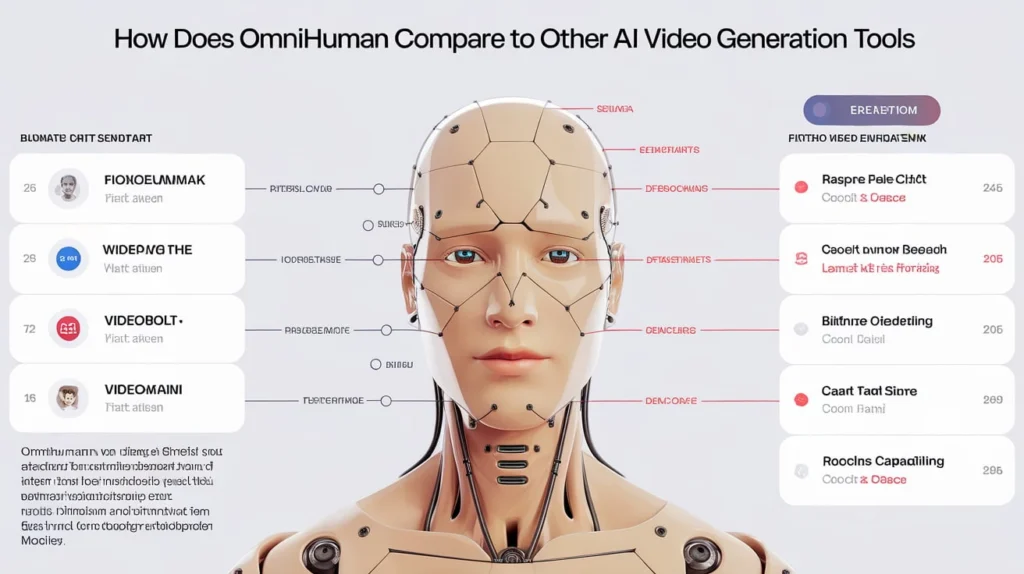
Use Case / RequirementOmniHumanRunwaySynthesiaPika / LTX / Veo etc.Human realism, full-body motionHighModerate (limited to stylized or broader scenes)Low (upper-body avatars only)Varies (stylized, less realistic)Input flexibility (image, audio, video, text)YesYes (text/image/video)Text / script + avatar selectionMostly text/image/videoOutput speed and easeEasy workflow from selfieRequires prompt crafting and editingEasy via templatesEasy for simple clipsLip sync and facial detailStrongMixed results on facesGood for static avatarsOften stylized or roughCinematic editing & creative controlLimited manual controlsFull editing tools & camera effectsMinimal controlVaries by tool (some control, some not)Best for useDigital humans, avatars, influencers, social mediaCinematic shorts, creative storytelling, film previsualizationTutorials, corporate, explainer, e‑learningMarketing clips, stylized videos, quick content
This table helps you match tool to need.
Situations where OmniHuman outshines others
If your project involves:
- Creating a digital human or virtual influencer from a single photo
- Making talking‑head videos with natural expressions
- Generating full-body motion or social media‑ready content from minimal assets
- Producing content without a camera crew or studio
Then OmniHuman offers unique advantages.
For example: a small marketing agency in Lahore could turn low-budget studio photos into engaging promo videos using OmniHuman, without hiring a film crew.
Another case: a content creator makes multilingual social media clips. Using OmniHuman plus text-to-speech, they get human avatars talking in several languages in realistic style.
Where you may prefer other tools
If your project demands:
- Extensive creative control: camera angles, scene composition, editing
- Cinematic storytelling or stylized visuals
- Long-form video, complex background, special effects
- Template-driven corporate or training videos with multilingual avatars
Then tools like Runway, LTX Studio, or Synthesia fit better.
For example: a brand producing a corporate training series might use Synthesia for its simplicity. A filmmaker seeking stylized dream-like visuals may prefer Runway.
Technical strengths of OmniHuman — What research shows
The academic paper behind OmniHuman — “OmniHuman‑1: Rethinking the Scaling-Up of One-Stage Conditioned Human Animation Models” — describes a model trained on mixed-condition data. That yields greater generalization. arXiv
The Diffusion Transformer architecture offers improved temporal coherence and higher resolution outputs compared to older U‑Net based diffusion models. TechNow+1
OmniHuman supports multiple driving modalities — audio only, video only, or hybrid. That flexibility distinguishes it from many single‑modality models. arXiv+1
Researchers highlight that OmniHuman handles difficult tasks like human-object interaction and complex body pose motions. arXiv+1
These technical advantages give OmniHuman strong potential for realistic human video generation and avatar creation.
When to pick OmniHuman over others
Choose OmniHuman if:
- You need realistic human avatars, not just abstract or stylized scenes
- Your resources for video production (camera, actors, studio) are limited
- You plan short, social, or marketing content needing human presence
- You want flexibility in inputs (image, audio, text)
Choose other tools if:
- Your project demands heavy editing, visual effects, or cinematic style
- You need control over camera angles, scene composition, or transitions
- You produce corporate, training, or explainer videos with professional avatars
- You need long-form narrative or heavy visual storytelling
Example Scenarios: Which tool fits best
Scenario 1: Social media personality launch
A creator wants to launch a “digital influencer” with minimal budget. They have only a selfie and a script.
- OmniHuman lets them generate a realistic video avatar speaking to camera, moving naturally.
- Useful for TikTok, Instagram Reels, YouTube Shorts.
- Lip-sync and facial expression give realistic feel without studio lighting or camera gear.
Other tools may require manual editing or lack realistic human motion.
Scenario 2: Corporate explainer videos for global audience
A company needs training videos in multiple languages.
- Synthesia works well: corporate-style avatars, multilingual voiceover.
- It delivers polished results, quick turnaround, predictable results.
OmniHuman could offer more realism, but it might demand more custom work or higher cost.
Scenario 3: Short film concept or music video
You have a creative idea: stylized visuals, cinematic camera moves, background effects.
- Runway or LTX Studio gives you control, editing tools, scene composition.
- You can manipulate camera angles, stylize visuals, combine footage.
OmniHuman might struggle with cinematic styling or scene-level editing controls.
What the industry says: Strengths and feedback
Review sites and industry analysts highlight OmniHuman’s unique offering: full‑body realistic animation from minimal inputs. Tech AICrunch+1
Some cite it as an ideal tool for digital humans and social content creators. Productivity Vision+1
However, public access and pricing remain uncertain. As of mid‑2025, OmniHuman lacked clear pricing or wide availability, making it less accessible for many creators. Tech AICrunch+1
Meanwhile, tools like Runway enjoy broader community adoption among filmmakers and creators. RouterPark+1
Key Recommendations
- If you need lifelike avatars and human motion from minimal inputs choose OmniHuman.
- If you need creative control, cinematic output, or heavy editing features choose Runway or similar.
- For corporate videos, training, or multilingual tutorials choose Synthesia or similar avatar-based tools.
- For stylized or animated clips — stylized, artful, or abstract — consider Pika or LTX Studio.
- Always test output quality. Use sample images, audio or scripts. Review lip sync, gestures, realism.
Future Outlook for OmniHuman
OmniHuman continues development. The team aims to enhance motion realism, reduce artifacts, improve hand and object interactions, and support longer video clips. Omni Human+1
Upcoming versions may sharpen realism, boost usability, and expand access. As adoption grows, licensing and pricing may stabilize.
If you follow AI video trends, OmniHuman is worth monitoring.
How does omnihuman compare to other ai video generation tools — final thoughts
OmniHuman offers a unique value: realistic human avatars, full-body motion, and flexible inputs. It suits content creators, marketers, educators, social media users. Other tools deliver more control, cinematic style, or template-driven simplicity.
Choose OmniHuman for human-centric, avatar-based videos, Runway or similar for creative storytelling. Choose Synthesia for corporate or language‑diverse training videos.
Your choice depends on your needs. Review your project goals, budget, and content type. OmniHuman stands out when realism and simplicity matter.
If you want, I can compare OmniHuman to 5–10 other AI video tools in 2025 for budget, output quality, and use case.
FAQs
What is OmniHuman AI and how does it work? OmniHuman AI is a platform that generates realistic human videos from a single image, audio, video, or text. It uses a Diffusion Transformer model. It merges input signals to animate avatars with natural facial expressions, lip sync, and body motion.
Is OmniHuman better than Synthesia for talking‑head videos? Yes in realism. OmniHuman offers full-body motion, facial expressions, and lip sync. Synthesia uses pre-made avatars and templates. Synthesia gives quick, predictable output. OmniHuman gives more lifelike results but needs careful setup.
Can I use OmniHuman for social media content creation? Yes. You can use just a selfie and a script or audio. You get human-like avatar videos ready for social platforms. The tool supports multiple aspect ratios. That suits vertical videos for mobile feeds.
Where does OmniHuman fall short compared to Runway? OmniHuman offers limited manual editing and cinematic controls. Runway gives full control over framing, camera, editing, effects. Runway suits complex scenes or stylized storytelling better.
Is OmniHuman suitable for commercial or marketing videos? Yes for projects needing realistic digital humans. It works for product promos, virtual presenters, social ads, or character-based promotion. For templated corporate videos, tools like Synthesia may offer faster results.