How many AI tools are there in the world is no longer a simple question with a fixed answer. The number grows every day. New products launch. Old ones shut down. Others merge into larger platforms. Therefore, any serious answer requires careful context, data, and definitions.
You use AI in search, use it in writing. You use it in design, coding, security, health, and finance. However, each of these uses counts as a different class of tools. Some serve consumers. Others serve large enterprises. Many operate behind the scenes without public visibility.
This guide gives you a clear, data-backed view of the global AI tools ecosystem. You will learn how many tools exist by category, what drives growth, and why the total keeps rising.
Defining What Counts as an AI Tool
Before counting, the term must stay precise. An AI tool refers to any software product that uses machine learning, deep learning, natural language processing, computer vision, or predictive algorithms as a core feature. Rule-based automation alone does not qualify.
AI tools fall into two broad types.
- End user tools such as chatbots, writing assistants, and image generators
- Embedded AI tools inside platforms such as fraud detection engines or recommendation systems
Both categories shape the total number. However, public directories track only end user tools in most cases.
According to Gartner and McKinsey research, more than 80 percent of enterprise software now includes at least one AI capability. That means thousands of tools never appear in public AI directories.
Current Global Estimates of AI Tools
There is no single global registry for AI tools. However, several large tracking platforms publish transparent databases. When combined, they give a reliable range.
Here are the most cited estimates for 2024 and early 2025.
- There are over 16,000 publicly listed AI tools across major global directories
- More than 6,500 of these launched after 2022
- Over 2,000 focus on content creation alone
- Over 1,500 operate in developer and automation workflows
These figures come from aggregated data across tools such as ThereIsAnAIForThat, G2, Product Hunt, Futurepedia, Exploding Topics, and GitHub repositories.
However, these directories exclude private enterprise AI systems. When enterprise-only and proprietary tools enter the count, experts at IDC estimate the global number exceeds 50,000 AI-powered tools and systems in active use.
Therefore, the answer to how many AI tools are there in the world depends on your scope.
- Public standalone AI tools. Around 16,000 to 18,000
- Total AI-powered software systems worldwide. Over 50,000 and rising
Growth Rate of AI Tools Since 2018
AI tools grew steadily from 2018 through 2021. The surge began in late 2022 after large language models reached mass adoption.
Product launch data shows three distinct phases.
Phase One. Experimental Growth. 2018 to 2020
Most tools targeted data scientists and researchers. Consumer access stayed limited. Fewer than 1,000 public AI tools existed in 2020.
Phase Two. Commercial Expansion. 2021 to 2022
No-code platforms and automation tools expanded AI access. The count rose to about 3,000 tools globally.
Phase Three. Mass Adoption. 2023 to Present
Generative AI reshaped the market. Text, image, video, voice, and music tools flooded every niche. The total jumped beyond 16,000 in less than two years.
Therefore, the market did not grow linearly. It exploded.
AI Tool Count by Category
To understand scale, you need category-level visibility. The total number holds little meaning without segmentation.
Content Creation and Copywriting
This remains the largest single category.
- Over 2,000 writing and blogging tools
- Over 1,200 paraphrasing and summarization tools
- Over 800 SEO AI platforms
These include tools for blogs, ads, emails, product descriptions, and scripts. Popular examples include ChatGPT, Jasper, Copy.ai, Writesonic, and Rytr. However, thousands of smaller niche tools also exist.
Image Generation and Design
- Over 1,100 AI image generators
- Over 600 AI design assistants
- Over 300 background removal and enhancement tools
This category expanded after diffusion models became widely available. Midjourney, DALL-E, Stable Diffusion, and Canva AI dominate usage share.
Video and Audio AI Tools
- Over 700 AI video generation platforms
- Over 500 AI voice and audio processing tools
These tools cover avatars, subtitles, dubbing, music, podcasts, and speech cloning. According to Deloitte research, AI-driven media creation grew faster than any other category in 2024.
Developer and Coding Tools
- Over 1,400 developer-focused AI tools
- Over 900 code completion and debugging platforms
GitHub Copilot alone serves millions of developers. However, thousands of smaller coding tools support testing, security scanning, documentation, and DevOps.
Learn more in our guide on AI code assistants for software teams.
Business Operations and Automation
- Over 1,200 workflow automation platforms with AI
- Over 900 analytics and forecasting tools
- Over 600 fraud detection and risk tools
These systems operate inside finance, logistics, retail, and manufacturing environments. Many never market themselves as AI products.
Customer Support and Chatbots
- Over 900 AI chatbot platforms
- Over 700 customer support automation tools
These tools handle live chat, ticket routing, and self-service knowledge systems.
Healthcare and Life Sciences
- Over 500 AI tools for diagnostics
- Over 400 tools for medical imaging analysis
- Over 350 tools for drug discovery
Regulation slows public release in this category. However, institutional usage stays high.
Education and Learning Tools
- Over 600 AI-powered learning platforms
- Over 400 AI tutoring systems
These tools serve schools, universities, and remote learners worldwide.
Cybersecurity and Threat Detection
- Over 450 AI security tools
- Over 300 automated SOC platforms
According to IBM Security, AI-driven threat detection cuts breach response time by over 40 percent on average.
Public AI Tools Versus Enterprise AI Systems
Most people interact only with public-facing tools. These appear in app stores, review platforms, and product directories. However, the larger volume of AI software operates inside companies.
Enterprise AI systems include:
- Demand forecasting engines
- Credit scoring models
- Medical diagnostics software
- Manufacturing defect detection
- Military and defense applications
These systems rarely appear in public databases. Instead, they exist as internal software assets.
McKinsey estimates that 74 percent of large enterprises now run at least three separate AI systems internally. That means the private side of the AI tool market remains much larger than the public side.
Regional Distribution of AI Tools
AI development concentrates in a few global hubs. However, regional growth patterns continue to shift.
United States
The United States hosts the highest number of AI vendors. Over 40 percent of known AI tools originate from US-based companies.
Silicon Valley, New York, Boston, and Austin lead innovation. Venture funding remains strongest in these regions.
Europe
Europe accounts for about 25 percent of global AI tools. The United Kingdom, Germany, France, and the Netherlands lead adoption. Strong GDPR regulation shapes responsible AI development in this region.
Asia Pacific
China, India, South Korea, and Singapore drive AI product growth across Asia. China alone reports several thousand AI companies across public and government-backed programs.
India shows the fastest growth rate in AI startups focused on SaaS, education, and finance.
Rest of the World
Latin America, the Middle East, and Africa represent emerging AI markets. Tool counts remain lower. However, growth rates stay high due to local demand in agriculture, microfinance, and language translation.
Open Source AI Tools and Their Impact on the Count
Open source projects expand the AI ecosystem beyond commercial tools. GitHub hosts tens of thousands of AI-related repositories. However, only a portion qualify as complete tools.
Notable impacts include:
- Stable Diffusion spawning thousands of derivative image tools
- Open source speech recognition engines powering hundreds of voice products
- Open source LLM frameworks enabling regional language models
Each open source model generates dozens of commercial derivatives. Therefore, the count of tools multiplies rapidly without centralized oversight.
Why the Total Number Keeps Rising
Several forces drive the rapid growth of AI tools.
Lower Technical Barriers
No-code and low-code platforms allow non-engineers to build AI-powered products. Cloud-based APIs remove infrastructure complexity.
Open Model Access
Open access to large models reduces development costs. Small teams now launch products once reserved for major research labs.
Industry-Specific Demand
Every sector seeks AI-driven efficiency. Legal, healthcare, logistics, and marketing each drive niche tool creation.
Global Remote Work
Remote work accelerates demand for automation, analytics, and virtual collaboration tools powered by AI.
Challenges in Accurately Counting AI Tools
Counting AI tools looks simple at first glance. It becomes complex upon closer inspection.
Key challenges include:
- Duplicate listings across multiple directories
- Tools rebranded after mergers
- Tools that pivot to non-AI offerings
- Internal enterprise systems with no public presence
- Regional language tools not indexed by western platforms
Therefore, any public count represents a conservative estimate.
Real-World Example of Market Expansion
Consider a small content agency in 2020. The team used one AI writing tool. Today, the same agency often uses multiple AI platforms.
- One tool for outlining
- One tool for drafting
- One tool for SEO optimization
- One tool for image generation
- One tool for video captions
This example reflects a broader market trend. Users now combine many specialized tools instead of relying on a single product. That behavior encourages developers to create narrower and more focused AI tools.
AI Tool Consolidation Versus Fragmentation
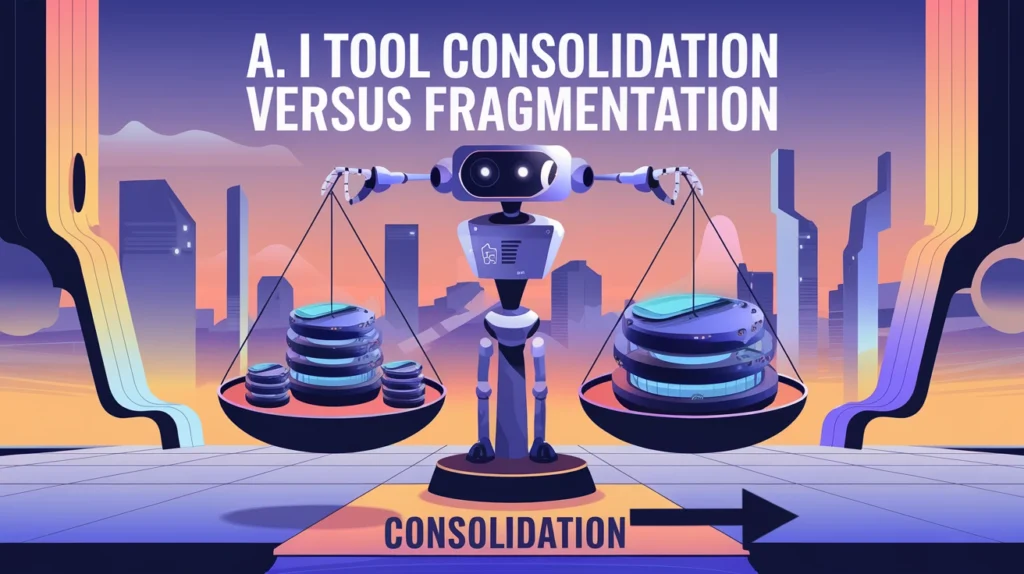
The market shows two opposing forces.
- Large platforms expand through acquisitions
- Small tools continue to launch rapidly
Major technology companies acquire promising startups to add features to core products. However, independent developers still release thousands of new tools each year.
According to CB Insights, AI startup acquisitions rose sharply after 2023. However, net tool count still increased because new launches outpaced consolidations.
How Many AI Tools Are There in the World by Use Case
The phrase how many AI tools are there in the world also differs by professional role. Here is how the count feels from a user perspective.
For Marketers
A digital marketer now chooses from over 3,000 AI tools across writing, SEO, ads, analytics, and automation. Tool overload already affects decision making.
For Developers
Developers face over 1,500 AI tools focused on coding, security, dev ops, and testing.
For Designers
Designers access over 2,000 AI tools spanning image creation, layout, branding, and motion graphics.
For Business Analysts
Analysts use over 1,000 AI platforms for forecasting, data mining, reporting, and anomaly detection.
Each role faces abundance rather than scarcity.
Quality Versus Quantity in the AI Tool Market
High tool counts do not guarantee equal quality. Only a small percentage achieve large-scale adoption.
- The top 5 percent capture most active users
- The middle 30 percent survive as niche products
- The remaining tools fade within two years
Gartner research shows average AI startup lifespan remains under four years without sustained revenue.
Therefore, while the number of tools grows, user trust concentrates in fewer platforms over time.
Regulation and Its Effect on Tool Availability
Government regulation shapes the future AI tool count.
- The European Union AI Act restricts high-risk AI deployment
- Data privacy laws limit training data access
- AI transparency requirements slow rapid launch cycles
These factors reduce the number of tools that reach commercial release in regulated industries such as health and finance.
However, creative and productivity tools face fewer regulatory barriers. Therefore, growth remains strongest in those categories.
Business Value Versus Experimental Tools
Not every AI tool delivers real business value. Many remain experimental.
You should evaluate tools based on:
- Data security practices
- Model accuracy benchmarks
- Integration capability with existing systems
- Vendor financial stability
Learn more in our guide on evaluating AI tools for business adoption.
How Investors Measure the AI Tool Market
Investors track three metrics.
- Total addressable market by industry
- Tool usage growth
- Revenue per user
According to PitchBook, global AI software revenue crossed 150 billion USD in 2024. Tool count alone does not define market health. Revenue concentration tells a deeper story.
The Role of Platforms in Tool Proliferation
Large platforms act as distribution engines.
- App marketplaces
- Browser extensions
- Plugin ecosystems
- API marketplaces
Each platform enables thousands of micro-tools built on shared infrastructure. For example, browser extension stores host hundreds of AI writing and summarization tools alone.
AI Tools in Government and Defense
Public sector AI tools remain less visible. Governments deploy AI for:
- Tax fraud detection
- Border security
- Traffic optimization
- Disaster response
These systems rarely appear in commercial listings. Yet they form a large portion of total AI deployments worldwide.
Ethical and Trust Implications of Tool Proliferation
A high number of AI tools introduces trust risks.
- Data misuse
- Hallucination errors
- Algorithmic bias
- Security vulnerabilities
Therefore, tool quantity must align with governance frameworks. Trust grows slower than tool availability.
Skills Demand Driven by AI Tool Growth
As tool numbers grow, skills demand rises.
- Prompt engineering
- AI system integration
- Data ethics and governance
- Model monitoring and validation
According to LinkedIn Workforce Reports, AI-related job postings increased by over 70 percent year over year since 2022.
The Future Trajectory of AI Tool Growth
Experts agree on three trends.
- Tool specialization will increase
- Platform consolidation will continue
- Regulation will shape release speed
By 2030, analysts at Accenture project the number of active AI tools and systems worldwide to exceed 100,000 when enterprise deployments reach maturity.
Therefore, the question is not whether the number will rise. The question is how fast oversight and governance will keep pace.
How Many AI Tools Are There in the World Today
Returning to the core question, how many AI tools are there in the world today depends on scope.
- Public standalone AI tools. Roughly 16,000 to 18,000
- Enterprise and proprietary AI systems. Well over 50,000
- Open source AI projects with tool-level functionality. Tens of thousands
No central authority governs this count. However, the growth pattern remains clear and accelerating.
How You Should Interpret These Numbers
Large numbers alone do not equal value. You should focus on:
- Tools aligned with your workflow
- Verified use cases
- Vendor maturity and compliance
- Ongoing model updates
Tool abundance increases choice. It also increases evaluation workload.
Practical Takeaways for Businesses and Creators
- Track only tools that match your use case
- Avoid surface-level feature comparisons
- Prioritize integration over novelty
- Review data handling policies before adoption
- Test tools with real workloads
These steps protect you from costly misadoption.
Why This Question Matters More Than Ever
The question of how many AI tools are there in the world reflects more than curiosity. It reflects market saturation, innovation velocity, and digital transformation speed.
AI now spreads the way mobile apps once did. Early adopters gain productivity advantages. Late adopters face rising competitive pressure.
The count will keep climbing. Your ability to evaluate and govern usage will define long-term success.
Conclusion
The global AI ecosystem now contains tens of thousands of tools when public and enterprise systems combine. However, only a fraction achieve widespread adoption. The rest serve niche needs across specific industries. As adoption grows, regulation, consolidation, and trust will shape which tools survive.
The exact number behind how many AI tools are there in the world will continue to change each year. What remains constant is the need for disciplined selection, governance, and continuous evaluation.
Your focus should stay on value, safety, and long-term alignment rather than raw tool count.
Frequently Asked Questions
How many AI tools are there in the world right now
Current estimates show over 16,000 public AI tools. When enterprise systems are included, the number exceeds 50,000. The total changes monthly due to rapid product launches.
Are most AI tools free or paid
Most tools offer freemium access. Paid plans dominate serious business use. Free tiers often limit output or features.
Which category has the highest number of AI tools
Content creation and marketing tools lead in total count. This includes writing, SEO, image generation, and video tools.
Do open source AI projects count as tools
Yes, when they provide complete functionality. Many commercial tools build on open source foundations.
Will the number of AI tools keep rising
Yes. Lower development barriers and rising demand across industries support continued growth.