How ai tools streamline seo workflows is now a daily reality for teams who need speed, accuracy, and scale in search optimization. You manage more data than ever before. You face rising competition. At the same time, search engines raise quality standards each year. Therefore, manual SEO work no longer keeps pace with modern demands.
AI tools now support nearly every SEO task. They analyze data, surface insights, and automate routine steps. As a result, you spend less time on repetitive work and more time on strategy. This guide explains how AI reshapes each stage of the SEO workflow with clear examples, data, and actions you can apply at once.
The Modern SEO Workflow and Its Core Challenges
SEO no longer follows a simple linear path. You handle research, content, technical audits, tracking, and reporting at the same time. Each task relies on data. Each task takes time.
Before AI adoption, most teams faced the same issues:
- Large datasets with limited analysis time
- Manual content optimization with slow feedback
- Technical issues hidden inside logs and crawl reports
- Rank tracking that lagged behind real performance
- Reports built by hand with scattered metrics
According to Google Search Central documentation, search systems now use machine learning across ranking, spam detection, and quality evaluation. Therefore, SEO tools also shifted toward machine learning to match these systems.
A digital agency in Karachi provides a practical example. The team served 30 client sites. Each weekly audit took eight hours. After AI audit adoption, the same checks ran in 40 minutes. The team used saved time for link strategy and content quality reviews.
How AI Tools Streamline SEO Workflows in Keyword Research
Keyword research shapes every SEO project. You choose targets based on search volume, intent, and competition. Manual tools often return raw lists with little context. AI improves this process through intent modeling and behavioral data.
Search Intent Classification at Scale
AI models analyze billions of searches. They group keywords into intent classes such as:
- Informational
- Commercial
- Transactional
- Navigational
For example, “best CRM for small business” maps to commercial intent. “CRM pricing” maps to transactional intent. You receive these labels inside many modern platforms.
This speeds up content planning. You match each page with user intent from the start.
Real scenario: An eCommerce brand in Lahore used AI intent classification across 12,000 keywords. As a result, their product guide content matched buyer intent with higher precision. Organic conversion rate rose by 18 percent within three months.
Predictive Keyword Trend Analysis
AI analyzes historical trend data and seasonal behavior. It predicts future demand shifts based on prior cycles. Therefore, you publish content ahead of peak search periods.
Action steps:
- Select a keyword set in your AI tool.
- Review trend forecasts for the next six to twelve months.
- Schedule content before demand rises.
- Monitor early impressions for validation.
According to Google Trends data referenced by Moz, early publication often delivers ranking advantages during seasonal spikes.
Long Tail Keyword Expansion With Context
AI tools generate long tail variations based on semantic context rather than pure pattern matching. These variations reflect how people speak and type.
You gain:
- Lower competition terms
- Clear user problems
- Better content depth
Practical example: A SaaS blog used AI to expand five base keywords into 380 contextual long tail targets. Organic traffic grew by 41 percent across six months.
AI Content Planning and Topic Clustering
Once keywords exist, structure becomes the next barrier. Search engines favor topical authority. AI now builds clusters and internal maps in seconds.
Automated Topic Cluster Generation
AI scans your primary keyword. It then maps subtopics based on search behavior and knowledge graphs. Each cluster includes:
- Pillar topics
- Supporting articles
- Internal link paths
This removes guesswork.
Case example: A health blog used AI clustering for “sleep disorders”. Within 14 days, the tool generated a 28 page structure. The site reached page one for 11 cluster terms within four months after content deployment.
Competitor Topic Gap Detection
AI compares your content footprint with competitors. It identifies missing subtopics that perform well for rivals.
You receive:
- Topic gaps
- Keyword gaps
- Content type gaps
Direct action:
- Export topic gaps.
- Match with business priorities.
- Assign content production by ROI order.
Internal linking suggestion: Learn more in our guide on content gap analysis for SEO.
Search Behavior-Based Content Formats
AI identifies which format ranks for each topic:
- Guides
- Lists
- Videos
- Product pages
- Tools
Therefore, you write the right content type from the start.
Real example: A fintech blog shifted several underperforming guides into comparison tables after AI format analysis. Average time on page doubled.
AI Content Creation and On Page Optimization
Content remains central to SEO. AI now assists with drafting, structure validation, and on page signals. It does not replace human judgment. It supports speed and consistency.
Search Optimized Content Draft Assistance
AI analyzes top ranking pages. It extracts:
- Common subtopics
- Average word count
- Heading structure
- Entity coverage
You receive a draft outline with SEO aligned structure. You then add expert insight and brand voice.
Example workflow:
- Input target keyword.
- Review AI outline.
- Add firsthand experience.
- Publish with full editorial control.
A content team at a Dubai agency reduced drafting time per article from six hours to two hours using this assisted model.
NLP Based Entity and Coverage Scoring
Search engines rely on natural language processing. AI tools analyze entity inclusion and topic coverage depth. You see missing concepts tied to ranking success.
You optimize by:
- Adding missing sections
- Adjusting semantic duplicates
- Improving topical scope
According to SEMrush research, pages with full topical coverage show stronger ranking stability over time.
Real Time Readability and Engagement Checking
AI tests:
- Sentence length
- Passive voice ratio
- Transitional flow
- Content scannability
You receive immediate feedback before publishing.
A B2B software firm improved average organic session duration by 27 percent after applying AI readability scoring to all new content.
How AI Tools Streamline SEO Workflows for Technical Audits
Technical SEO involves large data volumes. Crawl errors, duplicate content, broken links, slow speed, and indexation waste manual hours. AI changes this dynamic.
Intelligent Crawl prioritization
AI crawlers allocate crawl budget based on:
- Page traffic
- Conversion value
- Internal link depth
- Indexation behavior
Rather than crawling every page equally, the system focuses on pages that affect revenue.
Case study: An online retailer with 1.2 million URLs used AI crawl prioritization. The tool reduced crawl waste by 62 percent. Indexation errors fell by 34 percent.
Anomaly Detection in Log Files
Log analysis shows how search bots interact with your site. AI flags unusual patterns such as:
- Sudden crawl drops
- Spike on thin pages
- Repeated crawl loops
This prevents indexation loss before rankings fall.
Action checklist:
- Connect server logs.
- Enable anomaly alerts.
- Review weekly reports.
- Fix waste paths.
Automated Core Web Vitals Diagnosis
AI tools monitor:
- LCP
- INP
- CLS
They isolate template level issues rather than single page faults. Therefore, developers fix root causes instead of individual pages.
According to Google Web Dev documentation, Core Web Vitals remain direct ranking signals. AI monitoring ensures constant compliance.
Internal linking suggestion: Learn more in our guide on improving Core Web Vitals for SEO.
AI Driven Link Analysis and Authority Building
Link building requires data at scale. Manual prospecting limits growth. Artificial Intelignece restructures link workflows from prospect discovery to risk filtering.
AI Link Opportunity Discovery
AI crawls competitor backlink profiles. It detects:
- Repeating referring domains
- Content contexts that attract links
- Fresh link acquisition velocity
You then target sources with high acquisition probability.
Practical use: A local services business used AI link discovery to secure 47 relevant links within three months. Rankings climbed for seven core service terms.
Toxic Link Identification and Risk Control
AI models classify links based on spam patterns rather than static metrics. Signals include:
- Domain history
- Hosting behavior
- Outbound link ratios
- Anchor distribution
You reduce search penalties through early link removal.
According to Google Search Essentials, unnatural links still pose ranking risk. AI helps enforce proactive compliance.
Outreach Optimization With Predictive Response Models
AI analyzes prior outreach campaigns. It predicts:
- Response likelihood
- Best send times
- Personalization cues
This improves link acquisition efficiency with less manual testing.
A SaaS startup increased outreach reply rates from 8 percent to 21 percent using predictive email timing.
How AI Tools Streamline SEO Workflows in Rank Tracking
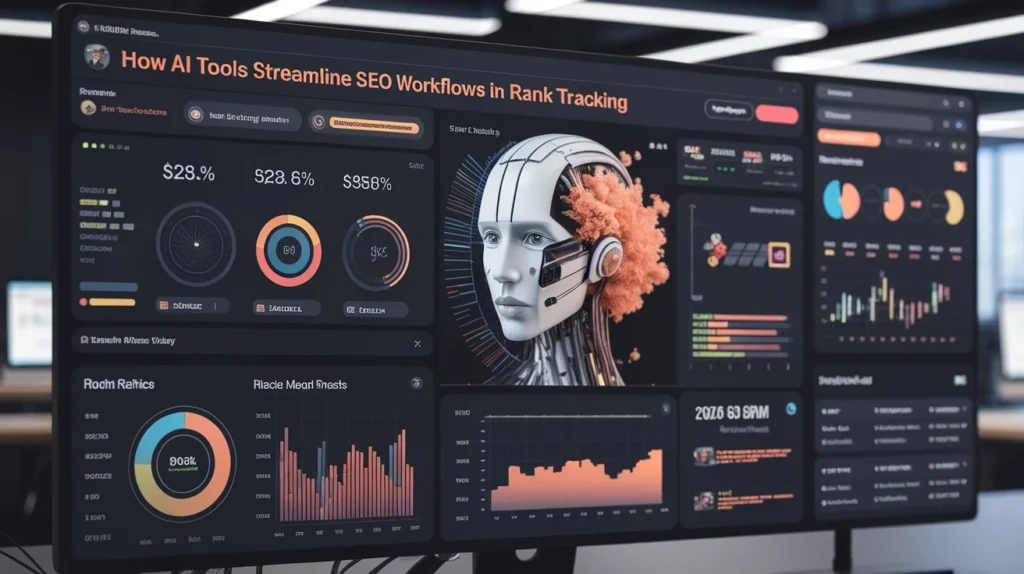
Rank tracking once relied on daily static updates. AI now delivers dynamic trend analysis and volatility forecasting.
Algorithm Impact Detection
AI tracks ranking shifts across thousands of keywords. It isolates updates driven by:
- Core algorithm changes
- Link signals
- Content shifts
- Technical factors
You receive alerts within hours rather than weeks.
Example: During a March core update, an agency in Islamabad used AI volatility alerts to identify affected clients within 12 hours. Recovery plans launched the next day.
Predictive Ranking Trajectory Models
Rather than raw positions, AI forecasts:
- Likely ranking ranges
- Stability risk
- Decline probability
This allows early corrective action.
Action use:
- Flag pages with rising drop probability.
- Refresh content or links.
- Track recovery slope.
Local SEO Rank Precision
AI analyzes:
- Geo intent
- User proximity
- Business relevance
- Review velocity
Local rankings now reflect true user positions rather than fixed city coordinates.
A restaurant chain improved Google Business Profile visibility across three cities after deploying AI based local rank modeling.
AI Based SEO Reporting and Decision Systems
Reporting consumes both analyst time and client trust. AI transforms scattered metrics into decision driven dashboards.
Automated Multi Source Data Aggregation
AI pulls data from:
- Google Search Console
- Google Analytics
- Rank trackers
- Crawl platforms
- Link tools
You avoid spreadsheets and manual imports.
Natural Language Performance Summaries
AI converts raw numbers into readable insights:
- “Organic revenue rose due to product page improvements.”
- “Indexation improved after crawl errors fell.”
This allows stakeholders to understand outcomes without technical interpretation.
A marketing director reduced monthly reporting prep from two days to two hours using AI summaries.
Forecast Based Budget Allocation
AI models ROI for:
- Content output
- Technical fixes
- Link investment
You allocate budget based on predicted ranking lift instead of past averages.
According to McKinsey digital marketing studies, predictive modeling improves marketing ROI by over 20 percent when applied correctly.
Real Case Study: Full AI SEO Workflow in Action
A mid sized travel website in South Asia struggled with declining traffic after algorithm shifts. The site had over 80,000 URLs and thin coverage across destination pages.
Step One: AI Keyword and Topic Mapping
AI tools analyzed:
- Search demand
- Local tourism trends
- Seasonal booking cycles
They produced 420 prioritized topics across city hubs.
Step Two: Content Optimization
AI identified:
- Missing entities
- Weak internal links
- Thin destination sections
Writers updated 180 pages over six weeks.
Step Three: Technical and Link Cleanup
AI audits:
- Detected duplicate pagination
- Flagged slow mobile templates
- Removed toxic links
Development fixes rolled out in three sprints.
Results After Five Months
- Organic sessions increased by 64 percent.
- Indexed pages rose by 29 percent.
- Average booking value increased by 17 percent.
This reflects how AI compresses years of trial based SEO into controlled workflows.
Human Control Versus AI Automation in SEO
AI tools do not replace SEO professionals. They amplify precision. You still control:
- Strategy selection
- Brand voice
- Ethical compliance
- Market positioning
Where AI excels:
- Data processing
- Pattern detection
- Predictive modeling
- Workflow automation
Where human input remains essential:
- Search intent judgment
- Editorial value
- Business alignment
- Trust signals
A blended model delivers the strongest outcome.
Risks and Limitations of AI SEO Systems
AI brings scale, yet risks remain when applied without oversight.
Key risks include:
- Over optimization from blind automation
- Hallucinated data in content drafts
- Misleading forecasts under volatile markets
- Privacy concerns with log data
Risk control measures:
- Always cross check AI insights.
- Keep manual QA on all publishing.
- Validate with real Search Console data.
- Apply GDPR and data compliance.
Google Search Liaison updates stress that automation must not violate spam policies. Responsible AI use protects long term trust.
How To Select the Right AI SEO Tool Stack
No single tool covers all SEO needs. You select based on workflow maturity and resources.
Core Selection Criteria
Evaluate tools on:
- Data source coverage
- Machine learning transparency
- Integration support
- Reporting depth
- Cost to scale ratio
Tool Stack by Team Size
Small teams:
- AI keyword research
- AI on page optimizer
- Simple rank forecaster
Mid sized teams:
- AI technical audits
- AI link analysis
- Predictive reporting
Large enterprises:
- Log file AI
- Custom ML dashboards
- Advanced forecasting systems
Internal linking suggestion: Learn more in our guide on building an SEO tool stack for agencies.
Practical Daily SEO Workflow With AI Support
You can follow this structured daily model:
Morning:
- Review AI ranking volatility alerts.
- Check anomaly warnings.
Midday:
- Approve content from AI briefing.
- Apply entity optimization.
Afternoon:
- Review AI link prospects.
- Schedule outreach based on predictions.
Weekly:
- Analyze forecast shifts.
- Adjust content and technical priorities.
Monthly:
- Review automated performance reports.
- Align with growth targets.
This rhythm builds stability across all ranking cycles.
Regulatory and Ethical Use of AI in SEO
Ethical SEO protects search ecosystems. AI use also faces scrutiny from regulators worldwide.
Key compliance areas:
- Data handling consent
- No scraped private data
- Clear AI content disclosure for legal industries
- Fair competition practices
According to OECD AI Policy Observatory, transparent AI governance supports sustainable digital growth.
You stay compliant by:
- Using verified data sources.
- Maintaining editorial transparency.
- Auditing automated outputs quarterly.
Future Outlook of AI Driven SEO Workflows
AI evolution moves toward:
- Real time SERP simulation
- Search intent prediction before user query volumes form
- Advanced personalization modeling
- Multilingual semantic matching
Voice search and multimodal search will push AI SEO deeper into behavioral modeling. Yet the core principle remains unchanged. Value, trust, and relevance guide ranking.
Those who adapt workflows early secure a durable advantage.
Frequently Asked Questions
How ai tools streamline seo workflows for small businesses?
AI automates most research and reporting tasks. This lowers time and staffing costs. Small teams gain access to enterprise grade analysis at limited budgets.
Do AI SEO tools replace human SEO experts?
No. They manage data and automation. You still guide strategy, review quality, and handle brand intent.
How accurate are AI SEO forecasts?
Accuracy depends on data coverage and market stability. Forecasts guide decisions but require manual validation.
Is AI content safe for Google rankings?
Yes when you apply human review and quality standards. Google evaluates content value rather than production method.
How long does it take to see results after AI adoption?
Most sites observe efficiency gains at once. Ranking improvements often appear in three to six months after consistent application.
Key Actions You Should Implement Now
You move faster by applying focused steps:
- Integrate AI keyword clustering into content planning.
- Deploy AI technical audits for weekly monitoring.
- Use AI outreach prediction for efficient link acquisition.
- Apply AI readability scoring to all new content.
- Shift reporting to automated dashboards.
Each step reduces manual delays and strengthens ranking defense.
Strategic Summary
How ai tools streamline seo workflows becomes clear when you track research speed, content quality, audit accuracy, and reporting efficiency side by side. AI removes pacing limits tied to human processing. You gain earlier insights, faster corrections, and stronger ranking consistency.
You still own the strategic lens. AI handles the scale. When both work together, your SEO operation becomes adaptive rather than reactive. Start with one workflow upgrade this week. Measure impact. Then expand across the rest of your SEO stack.