Introduction
Imagine scrolling through social media and suddenly seeing someone described as a “brat” in a comment thread. Is it an insult? A joke? A compliment hidden in sarcasm? Now imagine hearing a friend say, “She’s such a brat, but in the best way,” while smiling. The confusion is real because slang evolves quickly, and words like brat shift meaning depending on tone, context, and culture.
In modern slang, “brat” is no longer just the classic term for a misbehaving child. It has transformed into a flexible expression used in friendships, relationships, online communities, and even pop culture trends. Sometimes it signals playful attitude, sometimes rebellious confidence, and other times mild annoyance wrapped in affection.
Understanding what “brat” means today matters because it helps decode online conversations, avoids misunderstandings, and reveals how language reflects changing social attitudes. This article breaks down the slang meaning of “brat” in depth, exploring its origins, emotional tone, cultural usage, and real-life implications so you can confidently interpret and use it in context.
What Does “Brat” Mean in Slang?
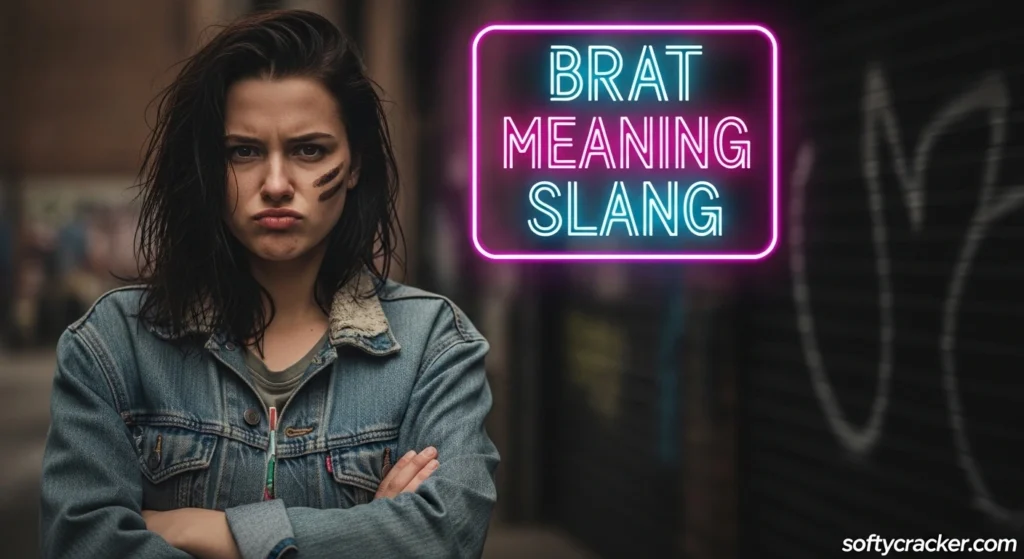
In modern slang, the word “brat” generally refers to someone who is playfully stubborn, slightly rebellious, or attention-seeking in a teasing or endearing way. Unlike its traditional definition—which describes a rude or ill-behaved child—slang usage often carries softer, more nuanced meanings.
A “brat” in slang is not always negative. It can describe someone who:
- Teases others in a charming or playful way
- Pushes boundaries without real malice
- Shows confidence mixed with a bit of attitude
- Acts spoiled or demanding but in an affectionate context
The meaning depends heavily on tone. For example, calling a close friend a “brat” while laughing usually signals affection rather than criticism. However, in a serious tone, it can still imply annoyance or disrespect.
In many cases, “brat” has evolved into a personality label rather than an insult. It captures someone who is bold, expressive, and not afraid to challenge expectations—often in a lighthearted manner.
The Origins and Evolution of the Word “Brat”
The word “brat” originally comes from Old English and early Germanic languages, where it referred simply to a child or offspring. Over time, especially in British and American English, it shifted toward describing children who were perceived as badly behaved or spoiled.
Historically, “brat” carried a strong negative tone. It was often used by adults to label children who were disobedient or overly demanding. However, language evolution—especially through internet culture—has softened and diversified its meaning.
In the digital age, especially with the rise of memes and social platforms, words often get redefined. “Brat” started being used humorously in comment sections and casual conversations to describe playful stubbornness rather than true misbehavior.
This shift reflects a broader linguistic trend: words once considered insults are often reclaimed or softened into playful identity markers. Today, “brat” exists on a spectrum ranging from affectionate teasing to mild criticism, depending entirely on context.
Brat in Social Media Culture
Social media platforms like TikTok, Instagram, and X (Twitter) have played a major role in reshaping the meaning of “brat.” In online spaces, tone is often playful, exaggerated, and ironic, which allows words like “brat” to take on new life.
Users might call someone a “brat” when:
- They are being playfully stubborn in a video
- They respond sassily or dramatically
- They show exaggerated confidence or attitude
The Meme Culture Effect
Memes often exaggerate personality traits for humor. In this environment, “brat” becomes less about judgment and more about entertainment. A “brat” character might be someone who refuses to cooperate in a funny, relatable way.
Influencer Usage
Influencers also use the term strategically to describe themselves or their personas. It can signal confidence, independence, or a slightly chaotic but lovable personality.
As a result, “brat” in social media culture often carries a fun, aesthetic identity rather than a strict definition.
Positive vs Negative Meanings of “Brat”
The meaning of “brat” depends heavily on emotional tone and relationship between speakers.
Positive Meaning
In a positive sense, a “brat” can be:
- Playfully stubborn
- Confident and expressive
- Energetic and attention-grabbing
- Lovably annoying in close relationships
In this context, it often feels affectionate, similar to calling someone “troublemaker” in a fond way.
Negative Meaning
In a negative sense, “brat” can imply:
- Entitlement or selfishness
- Disrespectful behavior
- Immaturity or lack of discipline
- Excessive attention-seeking
This version is more critical and can be insulting if used in a serious conversation.
The key difference lies in emotional intent. Without tone or context, the word can easily be misunderstood.
Personality Traits Associated with a “Brat”
People labeled as “brats” in slang often share certain behavioral traits. These traits are not universal, but they form a general pattern in how the term is used.
Common associations include:
- Strong-willed attitude
- Playful defiance
- Expressive emotions
- Desire for attention or validation
- Confidence that borders on boldness
In many cases, “brat” does not describe someone objectively bad or good—it simply highlights a personality that stands out socially.
Some individuals even embrace the label as part of their identity, using it to express independence and refusal to conform. In this sense, “brat” becomes less of a judgment and more of a personality style.
Brat in Relationships and Friendships
In personal relationships, especially friendships and romantic dynamics, “brat” often becomes a term of endearment rather than insult.
Friendly Usage
Among friends, calling someone a “brat” usually means:
- They are teasing or joking around
- They are being slightly dramatic
- Their behavior is annoying but lovable
Romantic Context
In romantic relationships, “brat” can take on an even more playful tone. It may describe a partner who:
- Enjoys playful arguments
- Seeks attention in a flirtatious way
- Challenges boundaries in a teasing manner
In some dynamics, the term is used affectionately to describe playful tension that strengthens connection rather than harms it.
However, if used without mutual understanding, it can also lead to miscommunication.
Brat as Playful Behavior vs Disrespect
One of the most important distinctions in understanding “brat” slang is separating playful behavior from disrespect.
Playful Brat Behavior
- Teasing without harmful intent
- Light resistance for humor
- Expressive, dramatic reactions
- Mutual understanding between people
Disrespectful Behavior
- Ignoring boundaries
- Acting entitled or dismissive
- Refusing cooperation in serious situations
- Lack of consideration for others
The same action can be interpreted differently depending on context. A playful “brat” in one setting might be seen as rude in another. This duality is what makes the slang both flexible and sometimes confusing.
Gender and Cultural Interpretations of “Brat”
The perception of “brat” can vary across cultures and gender expectations. In some societies, the word is more commonly used for children, while in others it extends into adult slang.
Gender Perception
- Women labeled as “brats” may sometimes be seen as playful, sassy, or attention-seeking.
- Men labeled as “brats” might be seen as rebellious or immature depending on context.
These interpretations are shaped by cultural expectations of behavior.
Cultural Context
In more conservative settings, “brat” may still carry a strongly negative meaning. In contrast, in online global culture, it is often softened into humor or aesthetic identity.
This shows how slang is not universal—it adapts to cultural norms and social attitudes.
“Brat Summer” and Pop Culture Influence
Pop culture has significantly amplified the slang usage of “brat,” especially through music, fashion, and online aesthetics. One notable example is the rise of “brat” as an aesthetic identity linked to confidence, chaos, and bold self-expression.
In pop culture contexts, a “brat” persona often symbolizes:
- Fearless individuality
- Loud, expressive personality
- Rejection of traditional expectations
- Fun, chaotic energy
Aesthetic Identity
The idea of a “brat aesthetic” has been embraced in fashion and online trends, where attitude and style blend into a unified identity. It is less about behavior alone and more about self-presentation.
This cultural shift shows how slang evolves beyond language into lifestyle branding.
Common Misunderstandings About the Word “Brat”
Because “brat” has multiple meanings, it is often misunderstood.
Misunderstanding 1: Always an insult
Many assume “brat” is purely negative. In reality, tone and context can completely change its meaning.
Misunderstanding 2: Only refers to children
While historically linked to children, modern slang often applies to adults as well.
Misunderstanding 3: Same in every culture
Different regions interpret the word differently, making global usage inconsistent.
These misunderstandings highlight the importance of reading context carefully rather than relying on dictionary definitions alone.
How Tone Changes the Meaning of “Brat”
Tone is the most important factor in interpreting “brat” in conversation.
- A laughing tone usually signals affection
- A sarcastic tone may imply teasing
- A serious tone can indicate criticism
- A playful tone suggests humor or flirtation
Even the same sentence—“You’re such a brat”—can mean completely different things depending on how it is said.
This makes “brat” a highly context-dependent slang term, where emotional cues matter more than literal meaning.
Real-Life Examples and Scenarios
To better understand how “brat” is used, consider these everyday scenarios.
Scenario 1: Friendship teasing
A friend refuses to share snacks and laughs while doing it. You call them a “brat” jokingly. This signals affection, not anger.
Scenario 2: Social media comment
Someone posts a dramatic video reacting to a minor inconvenience. A commenter says, “Such a brat energy.” This highlights playful exaggeration.
Scenario 3: Romantic dynamic
One partner playfully ignores messages just to tease the other. The response might be, “You’re being a brat today.” This reflects flirtation and familiarity.
In each case, the meaning shifts based on emotional closeness and intent.
Conclusion
The slang meaning of “brat” is far more complex than its traditional definition. What once described a misbehaving child has evolved into a flexible, emotionally layered term used in friendships, relationships, and online culture. Depending on tone and context, it can express affection, humor, mild frustration, or playful admiration.
Understanding this word requires more than dictionary knowledge—it requires attention to social cues, cultural context, and emotional intent. In modern communication, “brat” reflects how language adapts to personality expression and digital culture.
Ultimately, whether seen as teasing, endearing, or slightly critical, the word “brat” shows how even simple slang can carry rich, evolving meanings in everyday life.
FAQs
What does “brat” mean in slang?
In slang, “brat” usually refers to someone who is playfully stubborn, slightly rebellious, or attention-seeking in a teasing or affectionate way.
Is calling someone a “brat” offensive?
It depends on tone and context. It can be affectionate among friends or insulting if used seriously or harshly.
Can adults be called “brats”?
Yes, in modern slang, “brat” is often used for adults to describe playful or stubborn behavior.
Is “brat” always negative?
No. While it can be negative, it is often used in a humorous or affectionate way in casual conversation.
What is a “brat” personality?
A “brat” personality typically includes traits like playfulness, confidence, stubbornness, and expressive behavior.
What does “brat energy” mean on social media?
It refers to a bold, playful, slightly chaotic personality or vibe often seen in online content.
Why is “brat” popular in slang today?
Its popularity comes from social media, memes, and pop culture, where tone and personality-driven language evolve quickly.