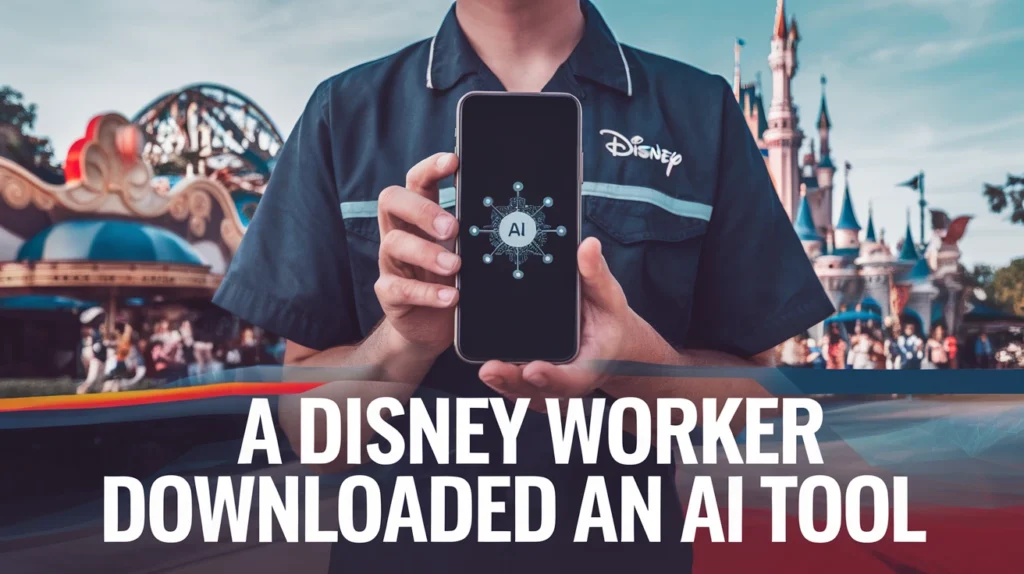
A Disney worker downloaded an AI tool while off the clock. That simple act exposed risks about corporate policy, intellectual property, and workplace trust. It forced their employer to re-evaluate access controls and data safeguards. It triggered a broader discussion about how companies should manage artificial intelligence. This article unpacks why this case matters to you, your firm, or your career.
Why This Story Matters
- Many companies now use AI. Roughly 78 percent of organizations worldwide report using AI in at least one business function by 2025. The Global Statistics+1
- A wide gap exists between adoption and actual business impact. One study shows 95 percent of generative‑AI pilots returned no measurable profit or loss impact. www.ndtv.com+1
- Unsupervised AI use inside large firms can expose sensitive IP, leak confidential data, or violate internal compliance rules.
- The case of the Disney worker highlights those risks in real terms rather than abstract warnings.
You could face similar risks if you insert AI tools into sensitive workflows without oversight, need to treat AI as a strategic resource, need rules. You need guards.
Rise of AI in Business: Scope and Limits
Global Shift Toward AI Tools
AI has moved from fringe experiments to mainstream adoption in firms around the world. According to a 2025 survey, 88 percent of organizations report at least one AI use case. McKinsey & Company Many firms now use AI across multiple departments — from marketing and sales to product development and customer service. McKinsey & Company+1
Larger enterprises lead adoption. Small firms lag behind. OECD+1
This growth makes AI tools easy to access. Many employees can download “consumer‑grade” AI software within minutes. Firms rarely block downloads on employee laptops. This increases risk.
Gains vs Real Business Impact
Companies often expect AI to slash costs or boost revenue. Many find it does not. A recent report claims 95 percent of generative‑AI pilots produced no measurable return on investment. www.ndtv.com
Still, firms see gains at the task or department level. AI helps content creation, automation, and repetitive tasks. That boost rarely scales across the whole firm. McKinsey & Company+1
Here is a breakdown:
MetricGlobal AI Adoption (2025)PercentageOrganizations using AI at least once78%The Global Statistics+1Firms experimenting with AI agents~62%McKinsey & CompanyFirms scaling AI across business units~33%McKinsey & Company+1Firms seeing measurable enterprise‑level profit gains~5–6%www.ndtv.com+1
This data shows that while AI use is widespread, proving meaningful business value remains hard. Many firms misinterpret productivity gains at task level for overall success.
What Happens When a Disney Worker Downloads an AI Tool
Imagine a creative employee at a large media firm. They download a generative AI tool to help write a pitch. They paste internal project notes into the tool. The tool runs analysis. It returns a stronger narrative. The flight is fast. The pitch wins.
On the surface, that looks like a win. But issues hide beneath.
Risk of Intellectual Property Exposure
The AI vendor stores inputs to refine its model. That means proprietary story outlines, timelines, and creative ideas may leak outside the firm. If the tool’s data library is not secure, the firm loses exclusive control. That loss erodes value.
An artistic firm like the one described — or a brand that trades on IP — may never recover.
Compliance and Contract Violations
Large firms often have strong internal rules. These rules restrict sharing internal reports, scripts, or design drafts outside secure systems. Using outside AI tools may break those rules.
It opens the firm to legal and licensing risks. It may void confidentiality agreements. The damage might take years.
Risk to Reputation and Trust
If company leadership finds out a worker used external AI without approval, they may view it as a breach. Not a breach of quality. A breach of trust.
That impacts promotions. It impacts team morale. It impacts future approvals.
Invisible Work Patterns
Many firms rely on structured workflows. Those workflows often yield audit trails — who touched what, when, and how.
Using an outside AI tool breaks that traceability. Future audits or compliance reviews cannot track input changes.
That gap raises red flags.
Why Small or “Side” AI Use Still Matters
You might think a quick AI download for a simple task is harmless. That view misses key issues.
- Third‑party AI tools operate outside corporate IT environment.
- Vendors may retain or reuse input data.
- AI output may misstate facts or hallucinate content. If that output goes to external clients, risk multiplies.
- Unvetted use undermines controlled workflows.
Even if you do not leak IP, you may still jeopardize quality control and compliance standards.
Why So Many Firms Fail to Capture Value from AI
After years of AI hype, deployment statistics show a struggle to translate tools into enterprise benefit. That struggle stems from core issues.
Lack of Strategy and Integration
Many firms treat AI as a new tool rather than a shift in process. They add AI to old workflows. That usually fails.
Few firms redesign core processes. That limits AI value at scale. McKinsey & Company+1
Weak Oversight and Governance
AI use spawns new risk. Without controls, firms face data leaks, biased output, or inaccurate results. Only a minority implement governance frameworks. S&P Global+1
Underestimating Compliance and IP Risks
Large creative firms often hold strong IP portfolios. Managers rarely consider leaks via AI models until after damage occurs.
They treat AI like a free tool rather than a strategic resource.
Overreliance on Individual Productivity Gains
Employees using AI at personal level might complete tasks faster. But those gains rarely translate into firm‑wide value.
Companies often need structural change to benefit financially. Many skip that step.
What Your Company Should Do: Governance, Policy, Training
If you run or advise a firm you should do the following steps:
Establish Clear AI Use Policies
- Define approved tools and forbid unknown tools.
- Clarify data access rules. Prohibit uploading internal documents to external AI tools.
- Require approval for AI usage in creative or sensitive work.
Provide Approved AI Tools Through IT Channels
- Offer enterprise‑grade AI tools via official channels.
- Manage access via company accounts.
- Monitor usage logs for compliance and audit purposes.
Conduct Employee Training
- Explain data privacy and IP risks.
- Show how to validate AI output.
- Encourage transparency. Ask employees to log any AI-assisted work.
Introduce Review and Quality Control Steps
- Review AI-generated drafts internally rather than sending them directly to clients or partners.
- Maintain version control and audit logs.
- Add human review before external release.
Prepare for Compliance and Legal Risk
- Ensure AI output does not violate copyright or licensing terms.
- Include clauses in employment contracts about AI usage and data handling.
What Individuals Should Do If They Use AI at Work
If you use AI tools as part of your job, follow these guidelines to avoid trouble:
- Use only approved tools.
- Do not submit sensitive or confidential information.
- Label any AI‑generated content clearly.
- Review all output carefully.
- Check with management or IT if you are unsure whether use is permitted.
Scenario: How the Disney Case Could Play Out
Imagine a creative writing team at a media firm. A junior employee downloads a public AI tool to refine a script. They paste internal notes. The output improves dramatically. They submit it to leadership. Leadership approves. The project moves forward.
Months later, a third party uploads the leaked script—now copyrighted by the firm—to an online database. The public sees it. Press picks it up. The firm investigates.
At that point the firm has to do damage control. They might face legal challenges, might need to re-secure IP ownership. They might lose trust inside the creative team.
This story may seem dramatic. But it reflects real risk.
Why the Firm’s Reaction Matters More Than the Tool
When firms react strongly to such cases it is not because they fear AI. They do it to protect systems, do it to protect ideas. They do it to protect reputation.
In some cases they may ban public AI tools altogether. In other cases they may allow limited, secure internal options.
What matters most is consistent policy and enforcement. That protects everyone.
What Research Says About AI Risks and Gains
Recent studies back up the concerns raised above.
- A 2025 report said only a small portion of firms captured value from generative‑AI initiatives. www.ndtv.com+1
- Many firms still pilot rather than scale AI efforts. McKinsey & Company+1
- Firms that do scale AI successfully often redesign workflows and integrate AI deeply across functions. McKinsey & Company+1
- ROI remains patchy. Firms see task-level gains more often than enterprise-level profit or efficiency increases. McKinsey & Company+1
These findings highlight the gulf between hype and reality.
How to Evaluate AI Tools for Your Organization
If you plan to allow AI at work use this checklist:
- Does the tool store or reuse input?
- Is the vendor trusted? How secure is their data handling?
- Does the tool support enterprise-level audit logs?
- Does the tool allow data segregation from public model training sets?
- Will using it comply with your IP, confidentiality, and compliance requirements?
- Do you provide employee guidelines and training before use?
No tool passes unless the answers satisfy both business goals and risk controls.
What Employers Often Overlook About AI Use
Employers frequently assume AI brings only benefits. They often overlook:
- Output inaccuracies or hallucinations.
- Hidden data leaks.
- Lack of traceability for creative contributions.
- Employee lack of awareness about IP and compliance risks.
- The need to rework internal review and approval workflows.
Ignoring those points can create bigger issues down the road than the gains justify.
Future Outlook for AI in Creative and Media Firms
AI will remain a powerful tool. Creative firms will adopt specialized solutions. These solutions will likely embed deep workflow controls. They will provide better security than public tools.
Creative firms that build internal AI platforms will protect confidentiality. They will control version history. They will track contributions.
Firms that fail to adapt risk leaks, lawsuits, and loss of reputation.
What You Should Do Next
If you lead a team or firm:
- Audit current AI usage across your firm.
- Draft an AI Acceptable Use Policy.
- Provide approved AI tools within a secure environment.
- Educate employees on risks and guidelines.
- Monitor usage and review output before external release.
If you are an employee:
- Ask whether your firm approves use of public AI tools.
- Use company‑approved tools only.
- Avoid uploading internal documents to external AI platforms.
- Flag and document any AI-assisted work.
These steps help protect ideas and maintain trust.
Conclusion
A Disney worker downloaded an AI tool. That simple act exposed a serious gap in corporate control, intellectual property safety, and workplace trust. As AI spreads across business functions, firms need strong policies. They need approved tools, review processes, and training. They need transparency. You have to treat AI not as a free add-on but as a strategic asset.
If your firm does not have AI governance today you should start implementing it. If you use AI in your role you should follow rules and document your work. That ensures creativity remains safe, controlled, and valuable.
That way you protect your firm, your career, and your ideas.
Internal link suggestion: Learn more in our guide on how companies implement generative AI securely.
Frequently Asked Questions
What should I do if a disney worker downloaded an ai tool at my firm? Report the incident immediately to your compliance or IT department. Evaluate risk to intellectual property and confidential data. Review usage logs and enforce secure AI policies.
Is it safe to let employees use public AI tools for creative work? No. Public tools store input data for model training. That creates risk of leaks of proprietary content. Use enterprise‑grade tools with data controls instead.
How many firms see real business value from AI adoption? Only a small share. Studies show about 5 percent of generative‑AI pilots generate measurable enterprise‑level value. Most yield gains only at task or department level. www.ndtv.com+1
What types of AI governance does a firm need? A firm needs defined policies, approved tools, access controls, employee training, audit logs, and output review. These measures reduce compliance, IP, and data risks.
Can unchecked AI use damage employee trust inside a company? Yes. Use of public AI tools without approval can break compliance. It may cause legal trouble. Leadership may lose trust in employees. That harms reputation and morale.