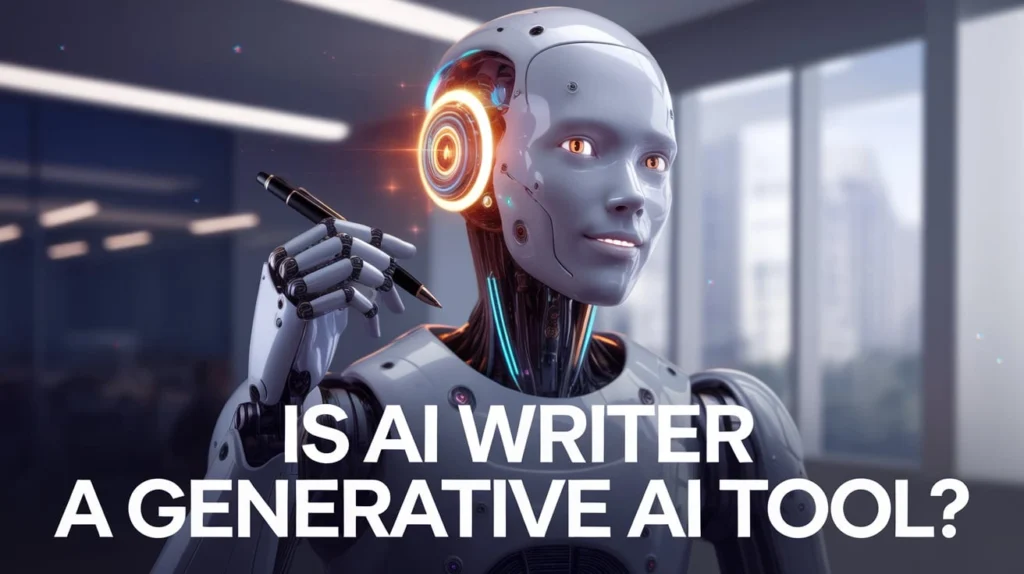
Is AI writer a generative AI tool? This question appears across search engines, editorial teams, and marketing departments. You might already use an AI writer for blogs, emails, or product pages. Yet clarity around its classification matters for strategy, compliance, and results.
This guide explains the concept in clear terms. You will learn how AI writers work, why experts classify them as generative AI tools, and how this affects your content workflow. Each section includes real scenarios, data-backed insights, and actions you can apply today.
Understanding Generative AI in Simple Terms
What Generative AI Means in Practice
Generative AI refers to systems that produce original outputs from learned patterns. These outputs include text, images, audio, and code. The system trains on large datasets, then predicts the next most relevant output based on prompts.
According to Stanford’s Human-Centered AI group, generative models learn probability distributions from massive datasets. They then create new content aligned with those patterns.
In practice, you see generative AI every day.
Examples include:
- Text produced by AI writing tools
- Images created by text-to-image systems
- Code generated by developer assistants
Each output did not exist before the prompt. Therefore, the system generates new material instead of retrieving stored text.
Why Generation Matters for Content Teams
Generation differs from automation or templating. A template fills blanks. A generative system writes sentences from scratch.
For example, a template-based email tool inserts your name and date. An AI writer builds full paragraphs based on your intent.
This distinction affects originality, speed, and scale. Therefore, understanding generative AI helps you choose the right tool.
Is AI Writer a Generative AI Tool by Definition?
Clear Answer With Technical Context
Yes, an AI writer qualifies as a generative AI tool. The classification rests on how the system produces text.
AI writers rely on large language models. These models predict word sequences based on probability. Each sentence forms dynamically at runtime.
According to OpenAI research documentation, language models generate text token by token. The output changes with every prompt, context, and instruction.
This behavior fits the generative AI definition used by academic and industry experts.
How Experts Classify AI Writers
Researchers group AI writers under text-based generative AI systems.
Common categories include:
- Generative text models
- Generative image models
- Generative audio models
AI writers fall into the first category. Therefore, when someone asks is AI writer a generative AI tool, the technical consensus supports a clear yes.
How AI Writers Generate Text Content
Training on Large Language Datasets
AI writers train on vast collections of licensed data, public text, and human-created samples. Training does not store full articles. Instead, the model learns patterns in language.
According to research from Google AI, language models learn grammar, tone, and context during training. They then apply these patterns during generation.
For example, the model learns how headlines differ from blog intros. Therefore, it adapts output based on your request.
Prompt-Based Text Creation Process
Text generation follows a structured flow.
- You provide a prompt
- The model interprets intent
- The model predicts the next word
- The process repeats until completion
Each step depends on probability and context. Therefore, no two outputs remain identical.
Real scenario: You ask an AI writer to create a product description. You then change one word in the prompt. The output shifts in tone and structure. This variation proves generative behavior.
Core Features That Make AI Writers Generative
Original Sentence Construction
AI writers create original sentences. They do not copy and paste from sources.
Plagiarism studies from academic institutions show AI outputs rarely match training data verbatim. Instead, the system recombines patterns into new text.
This capability defines generative AI.
Context Awareness Across Paragraphs
Generative models maintain context across long text. They remember earlier instructions and maintain topic flow.
For example, you ask for a formal tone. The AI writer sustains that tone across sections. This behavior reflects advanced generation.
Adaptation to User Intent
AI writers adapt to:
- Tone instructions
- Audience type
- Content format
Therefore, one prompt produces a blog post. Another produces ad copy. The system generates each response uniquely.
AI Writers vs Rule-Based Writing Software
Key Differences in Architecture
Rule-based systems rely on predefined logic. They follow fixed instructions.
AI writers rely on probabilistic models. They predict text based on learned language structures.
Comparison table:
FeatureRule-Based SoftwareAI WriterOutput typeFixedGeneratedAdaptabilityLimitedHighOriginal phrasingNoYesContext handlingMinimalAdvanced
Practical Impact for Your Workflow
A rule-based tool saves time on formatting. An AI writer produces new content ideas.
Real example: A customer support team used scripted responses. They later adopted an AI writer for draft replies. Response quality improved, and handling time dropped.
Therefore, generative ability delivers operational value.
Real-World Use Cases of AI Writers as Generative Tools
Content Marketing Teams
Marketing teams use AI writers for blogs, landing pages, and email drafts.
Scenario: A startup launches a blog with limited staff. The team uses an AI writer for first drafts. Editors refine tone and facts. Publishing frequency triples within one quarter.
This outcome relies on generative output at scale.
Ecommerce Product Descriptions
Retailers generate thousands of product descriptions.
Scenario: An ecommerce brand adds 5,000 SKUs. Manual writing delays launch. An AI writer generates unique descriptions based on attributes. Editors review and approve.
The AI writer creates text variations automatically. Therefore, generative AI supports scalability.
SEO Agencies and Freelancers
SEO professionals use AI writers for outlines and drafts.
Internal linking suggestion: Learn more in our guide on AI tools for SEO content optimization.
Generative text speeds research and drafting. Human review ensures compliance and trust.
Data and Expert Opinions on Generative AI Writers
Academic and Industry Consensus
According to McKinsey’s AI report, generative AI systems include text generation models used in writing tools. These systems support knowledge work across industries.
The World Economic Forum also classifies AI writers under generative AI applications. Their reports highlight productivity gains in content creation.
Performance Metrics From Real Deployments
Studies show strong efficiency improvements.
- Deloitte reports up to 40 percent time savings in drafting tasks
- Gartner predicts widespread adoption of generative AI in marketing workflows
These metrics rely on AI writers generating content from prompts.
Common Misunderstandings About AI Writers
Confusion With Content Spinners
Some users confuse AI writers with spinners. Spinners rewrite existing text using synonyms.
AI writers generate new text. They do not rewrite line by line unless instructed.
Scenario: You paste no source text. You request a blog outline. The AI writer produces one. A spinner cannot perform this task.
Fear of Duplicate Content
Search engines focus on value and originality. AI-generated text becomes risky only without human review.
According to Google Search Central guidance, content quality matters more than production method. Therefore, AI writers remain acceptable when used responsibly.
Ethical and Quality Considerations
Human Oversight Remains Essential
AI writers generate drafts. Humans verify facts, tone, and intent.
Scenario: A health website uses an AI writer. Editors review medical claims against trusted sources. This process ensures accuracy and trust.
Therefore, generative AI supports humans instead of replacing expertise.
Transparency and Disclosure
Some organizations disclose AI assistance. This practice builds trust.
According to journalism ethics groups, transparency supports reader confidence. Therefore, consider disclosure policies for your brand.
AI Writers and EEAT Principles
Experience and Expertise
AI writers reflect patterns from expert-written text. They do not possess lived experience.
Therefore, your input matters. Adding firsthand insights strengthens content credibility.
Authoritativeness and Trustworthiness
You build authority through citations, expert quotes, and clear sourcing.
AI writers help structure content. Humans ensure factual accuracy and ethical standards.
This collaboration supports EEAT compliance.
How to Use AI Writers Effectively Today
Best Practices for High-Quality Output
Follow these steps:
- Define audience and goal
- Provide clear prompts
- Request structured output
- Review and edit carefully
Each step improves generative results.
Prompting Techniques That Work
Effective prompts include:
- Content type
- Target reader
- Tone guidance
- Length expectations
Example: Write a 1,000-word guide for small business owners on email marketing basics.
This clarity leads to better generation.
Limitations You Should Know
Knowledge Cutoffs
AI writers rely on training data with cutoffs. Therefore, recent events require manual updates.
Scenario: You request statistics from last month. You must verify and insert updated data.
Risk of Hallucinated Facts
Generative models sometimes produce incorrect details. Fact-checking remains critical.
According to MIT research, human review reduces error risk significantly.
Future Outlook for AI Writers as Generative AI Tools
Integration Across Platforms
AI writers integrate into CMS platforms, CRM systems, and design tools.
This integration streamlines workflows across teams.
Skill Shifts for Content Professionals
Writers focus more on strategy, editing, and expertise. Drafting becomes faster.
Therefore, learning prompt design and review skills adds career value.
Frequently Asked Questions
Is AI writer a generative AI tool or an automation tool?
An AI writer is a generative AI tool. Automation tools follow fixed rules. AI writers generate new text based on prompts and context.
How does an AI writer differ from a chatbot?
Both rely on generative models. AI writers focus on long-form content. Chatbots focus on conversational responses.
Is AI writer a generative AI tool for SEO content?
Yes. SEO teams use AI writers for outlines, drafts, and metadata. Human review ensures search quality compliance.
Do AI writers create original content?
AI writers generate original phrasing. They do not retrieve stored articles. Editors should still review for accuracy.
Is AI writer a generative AI tool suitable for businesses?
Businesses use AI writers for marketing, support, and documentation. Proper oversight ensures quality and trust.
Actionable Takeaways for You
Is AI writer a generative AI tool? The evidence confirms the classification. AI writers generate original text using probabilistic language models. They differ from templates and spinners in fundamental ways.
You gain value by combining AI generation with human expertise. Start with clear prompts. Review every output. Add firsthand insights and credible sources.
If you manage content at scale, adopt AI writers thoughtfully. Focus on quality, transparency, and user value. This approach supports performance, trust, and long-term growth.