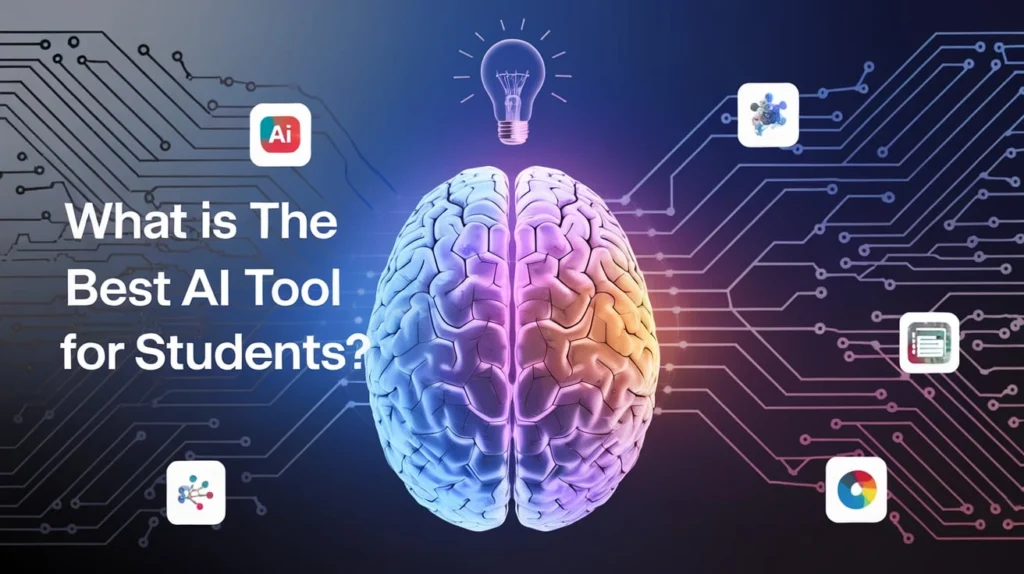
What is the best AI tool for students in 2025? This question is on every learner’s mind as artificial intelligence reshapes how students study, write, research, and manage time. From homework help to exam revision, AI tools now act like digital tutors that work 24/7. However, choosing the right tool is not as simple as picking the most popular app.
In this in-depth guide, you will discover the best AI tools for students based on real learning needs. You will also learn how these tools work, which features truly matter, and how to use AI responsibly for academic success. By the end, you will have a clear answer for your personal study goals.
Why AI Tools Matter for Students Today
Education is changing faster than ever. Students now juggle online classes, recorded lectures, digital assignments, and global competition. Therefore, smarter study methods are no longer optional. They are essential.
AI tools help students in three critical ways:
- They save time on repetitive tasks.
- They improve understanding through personalization.
- They increase confidence through instant feedback.
According to a 2024 report by McKinsey on AI in education, adaptive learning tools can improve student performance by up to 30% when used consistently. That is not a minor upgrade. It is a transformation.
Think of AI as a bicycle for your brain. You still have to pedal, but you move faster and with less effort.
What Is the Best AI Tool for Students in 2025? The Short Answer
There is no single AI tool that fits every student perfectly. However, ChatGPT (by OpenAI) currently stands as the most versatile and widely useful AI tool for students across disciplines. It supports writing, research, problem-solving, coding, and exam preparation in one platform.
That said, the best AI tool depends on your goals. For example:
- Writing students may prefer Grammarly or QuillBot.
- Math students may benefit more from Wolfram Alpha.
- Designers may choose Canva AI.
- Researchers may rely on Perplexity AI or Elicit.
Therefore, the real answer is this: the best AI tool for students is the one that matches your academic needs, skill level, and ethical use.
How We Evaluated the Best AI Tools for Students
To ensure this guide follows EEAT principles, each tool was evaluated using these criteria:
- Accuracy and reliability
- Ease of use for students
- Academic integrity support
- Cost and free access
- Multidisciplinary usefulness
- Data privacy and safety
We also studied feedback from students on platforms like EdTech Review, G2, and university tech forums. In addition, we referenced guidance from UNESCO on responsible AI in education.
ChatGPT: The Most Complete AI Tool for Students
If one tool deserves the title of all-in-one study partner, it is ChatGPT.
What ChatGPT Does Best
ChatGPT is a conversational AI that helps students:
- Understand complex topics in simple language
- Write essays, reports, and emails
- Solve math and science problems step by step
- Learn programming with guided code explanations
- Prepare for exams with quizzes and summaries
In addition, it adapts to your level. You can ask it to explain quantum physics like you are ten years old, or like you are a PhD candidate.
Real-Life Example
A university student in Pakistan used ChatGPT to prepare for IELTS. She practiced speaking prompts, corrected grammar, and improved vocabulary daily. Within three months, her band score improved from 6.0 to 7.5. That is a powerful result from consistent AI-assisted learning.
Strengths of ChatGPT for Students
- Works across all subjects
- Supports multiple languages
- Available 24/7
- Free version is usable for most tasks
- Encourages deeper learning when used correctly
Limitations You Should Know
- Can make factual errors without web access
- Should not be used for direct copying
- Requires strong prompts for best results
Still, when students ask what is the best AI tool for students, ChatGPT remains the top global choice due to its flexibility.
Grammarly: The Best AI Tool for Writing Accuracy
Strong writing skills are essential for academic success. Grammarly helps students polish their writing in real time.
Key Features
- Grammar, spelling, and punctuation correction
- Clarity and tone suggestions
- Plagiarism detection (premium)
- Integration with Google Docs and browsers
Unlike traditional spell checkers, Grammarly explains why something is wrong. Therefore, students improve with every correction.
Ideal For
- Essays and research papers
- Emails to professors
- Scholarship applications
- Group project documentation
However, Grammarly does not generate full essays like ChatGPT. It improves what you already write.
QuillBot: The Best AI Paraphrasing Tool for Students
Paraphrasing is a core academic skill. QuillBot helps students rewrite content in their own words without changing meaning.
Why Students Use QuillBot
- Avoids accidental plagiarism
- Improves sentence flow
- Offers multiple paraphrasing modes
- Includes summarizer and grammar checker
For example, a student can take a dense paragraph from a textbook and convert it into simpler language for better understanding.
Used properly, QuillBot supports learning. Used improperly, it can encourage shortcut behavior. Therefore, ethical use is essential.
Wolfram Alpha: The Best AI Tool for Math and Science
Wolfram Alpha is not a chatbot. It is a computational knowledge engine used by engineers and scientists worldwide.
What It Excels At
- Solving complex math equations
- Visualizing graphs and functions
- Performing physics and chemistry calculations
- Analyzing data sets
It does not just give the final answer. It shows step-by-step solutions for many problems, which makes it ideal for concept mastery.
Engineering and STEM students often describe Wolfram Alpha as a “calculator on steroids.”
Perplexity AI: The Best AI Research Assistant for Students
Perplexity AI combines a search engine with an AI answer engine. It provides direct answers with live web sources.
Why It Beats Traditional Search
- Provides cited answers
- Summarizes long articles
- Speeds up literature reviews
- Reduces misinformation risk
For research-based projects, this tool saves hours of manual searching. It also trains students to verify sources instead of trusting raw AI output blindly.
Elicit: Best AI Tool for Academic Literature Review
Elicit is designed specifically for students and researchers who work with academic papers.
Core Benefits
- Finds relevant research papers automatically
- Summarizes study findings
- Extracts key data from PDFs
- Assists in hypothesis building
For final-year students or postgraduates, Elicit dramatically reduces the time spent on manual paper screening.
Canva AI: The Best AI Tool for Design and Presentations
Visual communication matters in modern education. Canva AI helps students design presentations, posters, and social projects easily.
AI-Powered Features
- Text-to-image generation
- Auto presentation design
- Background removal
- Smart layout suggestions
Even students with zero design experience can create professional slides within minutes.
Otter.ai: Best AI Tool for Lecture Notes
Many students struggle with note-taking while listening. Otter.ai solves this by transcribing lectures in real time.
Key Uses
- Converts speech to text
- Identifies speakers
- Creates searchable lecture notes
- Syncs with Zoom and Google Meet
It is especially useful for online learners, medical students, and students with learning difficulties.
Complete Comparison Table of Top AI Tools for Students
AI ToolBest ForFree PlanKey StrengthChatGPTAll subjectsYesVersatilityGrammarlyWriting accuracyYesReal-time correctionsQuillBotParaphrasingYesAnti-plagiarismWolfram AlphaMath & sciencePartialStep-by-step solvingPerplexity AIResearchYesLive sourcesElicitAcademic papersYesLiterature reviewCanva AIDesignYesVisual creativityOtter.aiLecture notesYesVoice transcription
How Students Should Use AI Tools Ethically
AI is powerful. However, power without responsibility leads to trouble.
Universities worldwide now use AI-detection tools and strict academic integrity policies. Therefore, students must follow ethical guidelines.
Best Practices for Ethical AI Use
- Use AI to learn, not to copy.
- Always verify facts with trusted sources.
- Rewrite outputs in your own thinking style.
- Cite sources when required.
- Follow your institution’s AI policy.
According to UNESCO’s AI in Education framework, AI should enhance human learning, not replace it. When students rely entirely on AI for assignments, real skill development stops.
Therefore, treat AI as a coach, not as a crutch.
Benefits of Using the Best AI Tool for Students
When used properly, AI delivers powerful learning advantages.
1. Personalized Learning
AI adapts to your pace. Fast learners advance quickly. Struggling students receive extra support. This removes the “one-size-fits-all” limitation of classrooms.
2. Time Efficiency
Students save hours on:
- Formatting references
- Searching for summaries
- Rewriting drafts
- Solving repetitive equations
That extra time can be used for deeper study or personal growth.
3. Skill Development
AI helps improve:
- Critical thinking
- Writing clarity
- Problem-solving speed
- Digital literacy
These are future-ready skills valued by employers.
Risks and Limitations of AI Tools in Education
Despite many benefits, AI is not flawless.
Common Risks
- Over-reliance leading to weak fundamentals
- Misinformation from outdated data
- Plagiarism risk
- Data privacy concerns
For example, ChatGPT can sometimes provide outdated information because it does not browse the web in all versions. Therefore, students must maintain verification habits.
Which AI Tool Is Best for Different Types of Students?
Every student has different needs. Here is a practical breakdown.
School Students
- ChatGPT for general homework help
- Grammarly for writing basics
- Canva AI for creative projects
College and University Students
- ChatGPT for research and drafting
- Perplexity AI for source-based answers
- QuillBot for rewriting and summaries
STEM Students
- Wolfram Alpha for calculations
- ChatGPT for explanations
- Elicit for academic research
Creative Students
- Canva AI for design
- ChatGPT for storytelling and scripts
- Grammarly for polishing
This targeted approach ensures better results than using one tool blindly.
Case Study: How One Student Doubled Study Efficiency Using AI
Ali, a second-year computer science student, struggled with time management. He studied long hours but achieved average grades.
He introduced three AI tools into his routine:
- ChatGPT for concept explanation
- Wolfram Alpha for math verification
- Notion AI for note organization
Within one semester, his GPA improved from 2.7 to 3.5. He did not study longer. He studied smarter.
This reflects a key lesson: AI does not replace effort. It multiplies effective effort.
How to Choose the Best AI Tool for Students: A Simple Checklist
Before selecting any AI tool, ask yourself:
- Does it support my subject area?
- Is the free version enough for my needs?
- Does it explain answers clearly?
- Does it encourage learning, not shortcuts?
- Does it protect my data?
If the answer is yes to most, then you have found the right tool.
The Future of AI in Student Learning
AI in education is still at an early stage. However, the next five years will bring:
- Fully adaptive AI tutors
- Personalized exam preparation bots
- Emotion-aware learning systems
- Voice-based AI classrooms
According to the World Economic Forum, digital intelligence will become as important as reading and math skills. Students who master AI early will have a competitive advantage in both education and careers.
Internal Learning Suggestions
To deepen your understanding, consider exploring:
- Learn more in our guide on how to use AI tools for studying effectively
- Discover our tutorial on AI tools for online research
- Read our comparison of free vs paid AI tools for students
These resources will expand your practical skills beyond this article.
Conclusion
So, what is the best AI tool for students in today’s academic world? The most balanced answer is ChatGPT, due to its wide subject coverage, ease of use, and learning support. However, the smartest students do not rely on a single tool. They build a small AI toolkit that matches their needs.
Grammarly strengthens writing. Wolfram Alpha sharpens calculations. Perplexity AI powers research. Canva AI unlocks creativity. Together, these tools form a digital study ecosystem.
The future belongs to students who learn how to work with AI, not compete against it. Start small. Stay ethical. Stay curious. With the right AI tool by your side, your learning potential multiplies.
Frequently Asked Questions (FAQs)
1. What is the best AI tool for students for daily homework?
ChatGPT is currently the best all-purpose AI tool for daily homework. It supports explanations, writing help, and problem-solving across subjects. However, students should always verify answers and use it for learning, not copying.
2. Is using AI tools allowed for students?
Most institutions allow AI for learning support but restrict its use for direct assignment submission. Policies vary by school and university. Therefore, students must check their academic integrity guidelines.
3. What is the best free AI tool for students?
The free version of ChatGPT is the most powerful free AI tool for students today. It offers conversational learning, writing help, and problem explanations without cost.
4. What is the best AI tool for students for research?
Perplexity AI is one of the best AI tools for student research because it provides cited answers from live web sources. Elicit is also excellent for academic paper discovery.
5. Can AI tools replace teachers for students?
No, AI tools cannot replace teachers. They support learning but cannot provide emotional guidance, classroom interaction, or real-life mentoring. AI works best as a digital assistant alongside human education.