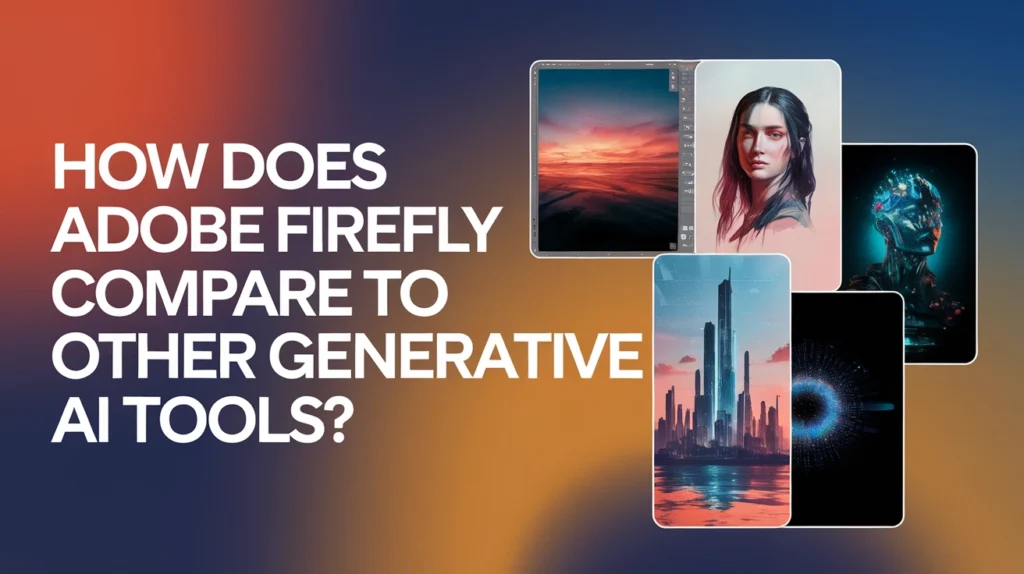
“How does adobe firefly compare to other generative ai tools” is a question many creative teams ask as they explore new AI design workflows. The rise of generative AI has transformed how we approach images, video, and content creation. However, each platform offers a unique blend of strengths, limitations, and use-case advantages. Adobe Firefly stands out because it aims to support creators with safe-to-use, commercially viable outputs that fit seamlessly into existing Adobe workflows.
In this guide, you will learn how Adobe Firefly stacks up against competitors like Midjourney, DALL·E, Stable Diffusion, Canva, Runway, and more. We will compare quality, features, control, licensing rights, ease of use, pricing, and the strategic direction of each tool. By the end, you will understand where Firefly excels, where it still lags, and whether it is the right choice for your creative process.
Why Adobe Firefly Matters in the Generative AI Landscape
Generative AI is not just a trend. It is a fundamental shift in how creators work. According to industry reports, AI-assisted design is already saving professionals hours every week, while unlocking creative possibilities they previously could not execute.
Adobe Firefly aims to do three things:
- Make generative AI safe for commercial use.
- Integrate AI into established design workflows like Photoshop, Illustrator, and Premiere Pro.
- Provide accessible creative tools for non-designers without compromising professional quality.
Other AI tools focus on innovation and visual output quality, but Adobe focuses on reliability, editing control, and industry compliance. This difference in philosophy shapes every aspect of how Firefly compares to its competitors.
What Makes Adobe Firefly Unique?
Adobe Firefly is built on Adobe-trained models designed for commercial use. While many AI tools pull training data from broad public internet sources, Adobe claims Firefly is trained only on licensed, public domain, and Adobe Stock-approved images. This provides peace of mind for businesses that worry about copyright risks.
Key Features of Adobe Firefly
Here are some of Firefly’s most distinctive features:
- Text-to-image generation
- Generative fill and object replacement
- Style transfer and reference image generation
- Text effects with stylized lettering
- Generative recolor for vector artwork
- Generative expand (uncropping or extending scenes)
- AI-assisted video tools (color, lighting, object removal)
- Prompt-based design templates in Adobe Express
The generative fill and vector recolor capabilities are particularly powerful because they use layer-based controls familiar to Adobe users.
Firefly’s Strengths at a Glance
Firefly excels in:
- Ease of use
- Seamless integration with Adobe Creative Cloud
- Safe-to-license commercial outputs
- Professional editing controls
- Reliable prompt interpretation
- Strong typography and vector-based AI tools
However, Firefly’s pure image quality still trails behind leading platforms like Midjourney for high-end artistic rendering.
How Does Adobe Firefly Compare to Other Generative AI Tools?
This is the core question: how does adobe firefly compare to other generative ai tools in real-world usage? Each AI platform has its own strengths. To make this easier to understand, here is a competitive overview table.
Comparison Table — Firefly vs. Major AI Competitors
Feature / Tool
Adobe Firefly
Midjourney
DALL·E
Stable Diffusion
Canva AI
Runway
Image Quality
Good
Excellent
Very Good
Varies by model
Good
Good
Ease of Use
Excellent
Moderate
High
Moderate
Excellent
Moderate
Commercial Safety
Very strong
Moderate
Strong
Varies
Moderate
Strong
Editing Control
Excellent
Limited
Good
Very strong with plugins
Good
Strong
Integration
Best-in-class
Limited
Moderate
Wide via APIs
Strong
Good
Best For
Designers, brands, editors
Artists, concept designers
Mixed creative use
Developers, custom workflows
Social creators
Video and multimodal creators
This overview sets the stage for a deeper exploration of each comparison below.
Adobe Firefly vs. Midjourney
Midjourney currently produces some of the best AI art in the world. Its image quality is stunning, hyper-detailed, and highly stylized. Many artists and concept designers prefer it for personal and professional creative projects.
However, Midjourney falls short in areas where Firefly shines.
Strengths of Midjourney
- Industry-leading visual quality
- Highly creative and imaginative results
- Unique, cinematic aesthetics
- Strong community on Discord
- Excellent style prompts
Strengths of Adobe Firefly
- Works directly in Photoshop, Illustrator, and Express
- Supports commercial use with fewer copyright questions
- Allows precise editing, masking, and layer control
- More consistent with realistic images
- Better for corporate workflows
Key Takeaway: If you want stunning art, choose Midjourney. If you want professional, editable, brand-safe content, Firefly is a stronger choice.
Adobe Firefly vs. DALL·E
DALL·E, created by OpenAI, offers high-quality text-to-image generation and strong editing tools through inpainting and outpainting. It tends to generate more realistic photographs than Midjourney, and its prompt interpretation is more literal.
DALL·E Strengths
- Strong realism
- Flexible editing through ChatGPT integration
- Great at matching prompt details
- Good balance between artistic and practical output
Firefly Strengths in This Comparison
- Better integration with creative software
- Safer licensing terms for brands
- Superior vector and text-effects capabilities
- More intuitive for non-technical users
Who should choose what? Choose DALL·E if you want accurate prompt rendering. Choose Firefly if you need editable creative assets for professional design projects.
Adobe Firefly vs. Stable Diffusion
Stable Diffusion is the most customizable generative AI model on the market. It is open-source and supports thousands of community-built fine-tunes. This makes it perfect for developers, AI researchers, and hobbyists who want full control.
Firefly, by contrast, focuses on simplicity and enterprise-grade safety.
Stable Diffusion Strengths
- Fully customizable
- Large ecosystem of models and checkpoints
- Local, private, or offline use
- Excellent fine-tuning options
- Huge control for advanced users
Firefly Strengths Compared to Stable Diffusion
- Much easier for beginners
- No need for advanced setup
- Seamless Adobe integration
- Reliable results for commercial workflows
- Strong editing tools without plugins
In short: Stable Diffusion is for tinkerers and developers. Firefly is for designers and business teams that need dependable, editable content.
Adobe Firefly vs. Canva AI
Canva AI is built for speed, simplicity, and social media creators. It allows users to create templates, graphics, and videos with minimal skill required.
Where Canva Wins
- Quick, drag-and-drop workflows
- Hundreds of AI templates
- Great for non-designers
- AI-driven branding kits and social tools
- Fast text-to-image generation
Where Firefly Wins
- Higher quality outputs
- More professional and precise editing
- Better control over styles and layers
- More suitable for print-quality and enterprise use
- Stronger brand safety and licensing
Who should choose what? Canva is excellent for beginners, small businesses, and influencers. Firefly is ideal for professional designers and brand teams.
Adobe Firefly vs. Runway (Video AI)
Runway is one of the most advanced AI video generation and editing tools available today. It excels in creating AI-generated videos, removing objects, and editing footage in intuitive ways.
Firefly is catching up by integrating AI features inside Adobe Premiere Pro and After Effects.
Runway Strengths
- State-of-the-art video generation
- Fast object removal tools
- Advanced motion tracking
- High-quality AI video models
- Great for experimental creators
Firefly Strengths for Video Editors
- Native integration with Adobe’s industry-standard video apps
- Layer-based control inside Premiere and After Effects
- Strong tools for lighting, color correction, and cleanup
- Consistent professional workflows
Runway is best for: Creatives who want to experiment with full AI-generated videos.
Firefly is best for: Professional editors who need reliable tools for real client work.
Which Generative AI Tool Is Best?
There is no single winner. Instead, each platform dominates in specific areas.
Pure Image Quality
- Midjourney
Commercial Safety
- Adobe Firefly
Detailed Prompt Interpretation
- DALL·E
Developer Flexibility
- Stable Diffusion
Beginners and Social Media
- Canva AI
Video Innovation
- Runway
Firefly is not the most creative tool, but it is the most consistent for brands and professional editors who need editable, safe, and reliable assets.
Real-World Example: Firefly in a Marketing Workflow
Imagine a design team preparing a global advertising campaign. They need consistent visuals across digital ads, billboards, and social content. With Firefly, they can:
- Generate on-brand visuals using reference images.
- Use generative fill to adjust scenes without reshooting.
- Recolor vector logos for seasonal variations.
- Expand images for different aspect ratios.
- Export directly to Photoshop, Illustrator, and InDesign.
This workflow is seamless compared to juggling separate apps like Midjourney or Stable Diffusion. It also reduces risk because the generated images are safer for commercial use.
Strengths and Weaknesses of Adobe Firefly
Strengths
- Seamless Adobe integration
- Safe, commercially usable outputs
- Easy for beginners, powerful for pros
- Excellent generative fill and vector recoloring
- Reliable results for corporate use
- Friendly user interface
- Strong support and documentation
Weaknesses
- Not the most artistic outputs
- Can feel more “corporate” and less experimental
- Fewer fine-tuning options
- Slower innovation compared to open-source models
- Sometimes struggles with complex details like hands or crowds
Future Outlook: Where Adobe Firefly Is Heading
Adobe is investing heavily in AI across all its apps. According to Adobe product updates, future Firefly releases will further enhance:
- AI-driven video generation
- 3D and animation capabilities
- Better realism and detail in image generation
- Improved brand-specific training models
- Faster performance inside Creative Cloud apps
- More control over style, lighting, and camera settings
Adobe’s roadmap suggests Firefly will not compete on novelty alone. Instead, Adobe is building AI that supports professional creative workflows end-to-end.
Final Comparison — How Does Adobe Firefly Compare to Other Generative AI Tools?
By now, you should have a complete understanding of how does adobe firefly compare to other generative ai tools in practical, real-world use cases.
Firefly is:
- Not the most artistic tool (Midjourney wins)
- Not the most detailed (DALL·E wins)
- Not the most customizable (Stable Diffusion wins)
- Not the fastest for social content (Canva wins)
- Not the best for experimental video (Runway wins)
However, Firefly is the best overall for brands, designers, editors, and businesses who need safe, reliable, editable creative assets with clear licensing. It is the most integrated solution, and that makes it invaluable for professional workflows.
If generative AI tools were cars, Midjourney would be a sports car, Stable Diffusion would be a customizable race kit, DALL·E would be a balanced sedan, and Firefly would be the dependable, high-performance SUV designed for long-term use. Not the flashiest, but the most practical for daily work.
Conclusion: Why Adobe Firefly Stands Out
In conclusion, the answer to how does adobe firefly compare to other generative ai tools depends on what you need. Firefly offers unmatched ease of use, commercial safety, and seamless integration within Adobe Creative Cloud. While other tools may produce more artistic or experimental visuals, none match Firefly’s reliability inside professional workflows.
If you are a business, marketer, designer, or editor who wants AI that fits your existing process, Firefly is a smart choice. It saves time, reduces creative risks, and helps teams produce polished work faster. For artists seeking pure creativity, other platforms may still be worth exploring. Ultimately, the best tool is the one that supports your unique goals — and Firefly delivers exceptional value for real-world creative work.
FAQs About How Adobe Firefly Compares to Other Generative AI Tools
1. Is Adobe Firefly better than Midjourney?
Firefly is better for commercial work, editing, and integration with Adobe apps. Midjourney is better for artistic visuals. Choose based on your creative goals.
2. How does Adobe Firefly compare to other generative AI tools for business use?
Firefly offers clearer licensing, safer commercial outputs, and tighter integration with professional tools. This makes it one of the best options for brands and enterprises.
3. Does Adobe Firefly produce higher-quality images than DALL·E or Midjourney?
Not yet. Firefly focuses on reliability and control, while Midjourney and DALL·E produce more artistic or photorealistic results. However, Firefly continues to improve each version.
4. Is Adobe Firefly good for beginners?
Yes. Firefly is extremely easy to use, especially inside Photoshop and Express. Beginners appreciate the friendly interface and consistent outputs.
5. Does Adobe Firefly allow commercial use?
Yes. Adobe designed Firefly with commercial safety in mind. Its training data and licensing rules are clearer than many other AI tools, which reduces copyright risks.