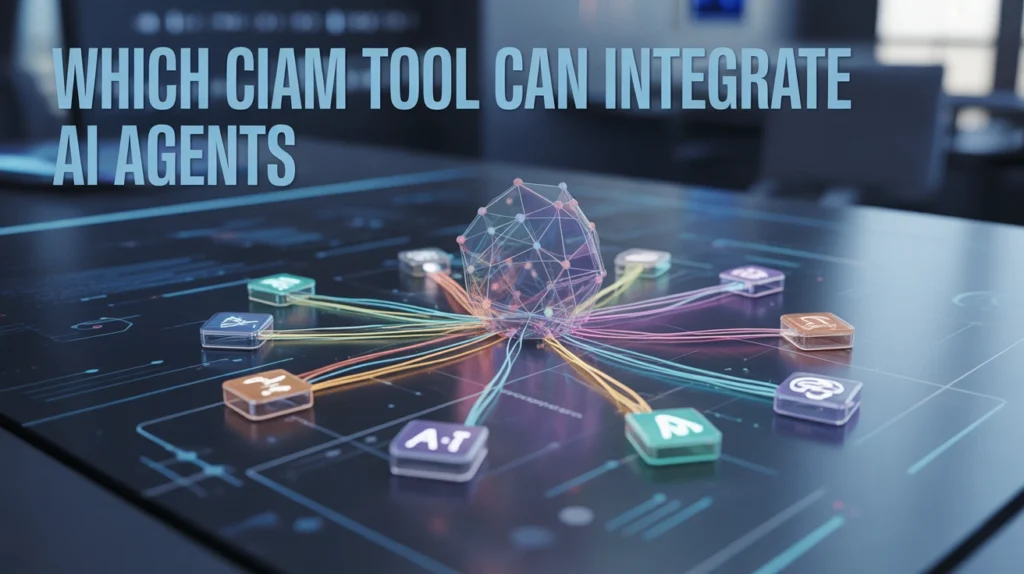
Managing digital identity securely while delivering personalized experiences has become crucial in modern business. As organizations adopt Customer Identity and Access Management (CIAM) systems, the next wave of innovation focuses on AI agent integration — combining identity intelligence with automation.
But which CIAM tool can integrate AI agents effectively? This guide explores leading CIAM platforms that support AI-driven features and integrations, their real-world applications, and how AI agents are transforming identity management.
Understanding CIAM and Its Role in Digital Identity
Before identifying which CIAM tools integrate AI agents, it’s essential to understand what CIAM actually is.
Customer Identity and Access Management (CIAM) solutions help businesses securely manage how customers log in, register, and interact with digital services. Unlike traditional IAM (Identity and Access Management), CIAM focuses on the customer experience — balancing security, convenience, and compliance.
Core Functions of CIAM:
- Authentication and Authorization
- Single Sign-On (SSO) and Social Login
- Multi-Factor Authentication (MFA)
- User Consent and Privacy Management
- Data Governance and Compliance (GDPR, CCPA)
Now, with AI agents entering the picture, CIAM tools can go beyond authentication — enabling intelligent, adaptive, and predictive identity experiences.
The Rise of AI Agents in Identity Management
AI agents are autonomous or semi-autonomous systems that can perform complex tasks by interpreting data and responding intelligently. In the context of CIAM, AI agents bring several advantages:
- Fraud detection through behavioral analytics.
- Dynamic authentication that adapts to user risk levels.
- Personalized customer experiences based on login history and engagement patterns.
- Identity orchestration, automating workflows like onboarding or password recovery.
When CIAM tools integrate AI agents, they bridge the gap between security automation and customer personalization — creating a smarter identity layer.
Criteria for Choosing a CIAM Tool That Can Integrate AI Agents
When evaluating which CIAM tool can integrate AI agents, look for the following key features:
- Open API Architecture: Enables AI or machine learning system integration easily.
- Support for External AI Frameworks: Compatibility with models like OpenAI, TensorFlow, or AWS AI.
- Behavioral Analytics and Risk Scoring: Built-in AI or ML for detecting anomalies.
- Identity Orchestration Capabilities: Automation workflows that use AI logic.
- Integration with Chatbots and Virtual Assistants: For customer self-service and identity verification.
- Data Privacy and Compliance: AI use must still comply with privacy regulations.
With these factors in mind, let’s explore the top CIAM tools that are leading the charge.
1. Okta Customer Identity Cloud (Auth0)
Okta, one of the most recognized CIAM providers, offers AI-powered adaptive authentication and an extensible identity platform through its Auth0 engine.
Key AI Integration Features:
- Adaptive MFA: Uses AI-driven risk assessment to determine authentication requirements.
- Behavioral analytics: Detects unusual login patterns and triggers AI-based actions.
- Custom API support: Allows seamless integration with AI agents, including GPT-based assistants or proprietary AI workflows.
- Identity orchestration: Through Okta Workflows, you can automate identity-related processes using logic and AI triggers.
Why It Works: Okta’s developer-friendly APIs make it an ideal choice for companies that want to integrate AI-powered assistants for login support, security monitoring, or customer interaction.
2. Ping Identity
Ping Identity is a pioneer in enterprise-grade identity solutions. It provides built-in intelligence and AI-powered risk management.
AI Integration Capabilities:
- PingOne Protect: Uses AI to detect suspicious authentication patterns.
- Integration-ready APIs: Developers can connect external AI agents for decision automation.
- Risk-based authentication: Combines machine learning with contextual data.
- AI chat support integration: Ping supports chatbot and digital assistant plugins for CIAM workflows.
Why It Works: Ping Identity’s platform is modular, which allows enterprises to plug in AI systems for continuous authentication and dynamic customer support.
3. ForgeRock Identity Cloud
ForgeRock offers a comprehensive identity platform built for scale and flexibility. Its Intelligent Access feature is where AI comes to life.
AI Agent Integration Features:
- Intelligent Access Trees: Enables drag-and-drop orchestration of identity flows that can call external AI services.
- Adaptive Authentication: AI-driven decisions adjust user friction levels dynamically.
- Integration-ready SDKs: Connect to OpenAI, Google Cloud AI, or AWS Lambda for AI agent processing.
Why It Works: ForgeRock’s architecture makes it perfect for deploying AI-powered chatbots, fraud detection agents, or adaptive user journeys.
4. Microsoft Entra External ID (Azure AD B2C)
Microsoft’s Entra External ID, formerly known as Azure AD B2C, is a leading CIAM service that easily integrates with AI through Azure Cognitive Services.
AI Integration Advantages:
- Seamless integration with Azure AI tools like Cognitive Services, Language Understanding, and Computer Vision.
- AI-driven identity protection for risk-based authentication.
- Custom API connectors for AI-driven chatbots, sentiment analysis, or fraud scoring.
Why It Works: If your organization already uses Microsoft Azure, integrating AI agents is straightforward — making it one of the most AI-flexible CIAM ecosystems.
5. IBM Security Verify
IBM Security Verify combines CIAM capabilities with powerful AI-driven identity analytics.
AI Capabilities:
- Watson AI integration for behavior analytics and anomaly detection.
- Adaptive access based on real-time contextual evaluation.
- Data insights: Uses AI for identity risk scoring.
- API-driven customization: Supports external AI models and conversational agents.
Why It Works: IBM’s Watson-powered analytics allow organizations to identify and mitigate threats using intelligent automation and predictive modeling.
6. SAP Customer Data Cloud (formerly Gigya)
SAP Customer Data Cloud focuses on customer trust, data privacy, and personalization.
AI Agent Integration Features:
- Integration-ready through SAP Business Technology Platform (BTP), which connects to AI modules.
- Predictive analytics for personalization and security.
- Supports conversational AI bots that connect with CIAM data for customer interactions.
Why It Works: If your business runs on SAP, this CIAM tool can integrate AI-driven customer engagement and personalization natively.
7. AWS Cognito with AI Agent Integration
Amazon Cognito is a lightweight yet powerful CIAM service designed for scalability.
AI Integration Strengths:
- Integration with AWS AI services: Direct connections to Amazon Rekognition, Comprehend, and Lex (AI chatbot).
- Event triggers: Use AWS Lambda to activate AI agents on specific identity events.
- AI-driven adaptive security: Detects suspicious sign-in activity and applies automated responses.
Why It Works: For developers and startups, AWS Cognito is a flexible solution that can integrate AI agents for authentication, user verification, and chat automation without complex setup.
8. Transmit Security CIAM Platform
Transmit Security is a modern, passwordless CIAM solution that uses AI and biometrics to streamline user verification.
Features:
- AI-based fraud detection using device and behavior patterns.
- Integration-ready API for AI-driven assistants.
- Supports facial and voice recognition AI models.
Why It Works: Transmit Security blends AI-driven biometrics with identity workflows, offering both security and convenience.
How AI Agents Enhance CIAM Performance
AI agents improve CIAM systems in several ways beyond just automation.
1. Dynamic Authentication
Instead of static MFA, AI agents continuously analyze user behavior, device type, and location to adjust verification requirements.
2. Fraud Detection and Risk Scoring
AI identifies subtle anomalies — like impossible travel or abnormal login times — to prevent unauthorized access.
3. Customer Support Automation
AI agents can handle password resets, profile updates, or verification queries conversationally via chatbots.
4. Personalized Experience
AI can customize login flows or recommend actions based on user behavior, improving retention and satisfaction.
Integration Example: Okta + ChatGPT AI Agent
Here’s a practical example: A company using Okta CIAM can integrate an AI agent powered by GPT to assist users during authentication.
- When a login fails, the AI agent can guide users through troubleshooting steps.
- If multiple failures occur, the agent triggers adaptive MFA automatically.
- The agent can also report anomalies to admins through Slack or email alerts.
This real-world integration showcases how AI and CIAM can create an intelligent, secure, and user-friendly environment.
Future Trends: AI + CIAM Evolution
AI-driven CIAM is still evolving. Over the next few years, we can expect:
- Autonomous identity governance, where AI agents make policy recommendations.
- Predictive user verification, detecting risks before login attempts.
- Emotion-aware customer service agents, offering empathy-driven interactions.
- Cross-platform identity intelligence, where AI unifies digital identity across devices and ecosystems.
As AI becomes more advanced, CIAM tools will transform from access managers into intelligent identity ecosystems.
Conclusion
So, which CIAM tool can integrate AI agents most effectively? The leading options are Okta, Ping Identity, ForgeRock, Microsoft Entra, IBM Security Verify, and AWS Cognito. Each provides the flexibility, APIs, and intelligence required for seamless AI agent integration.
If your goal is to enhance user experience and automate identity workflows, start by testing how AI agents interact with your chosen CIAM platform. The combination of CIAM + AI will define the future of secure, personalized digital access.
FAQs About Which CIAM Tool Can Integrate AI Agents
1. What does CIAM stand for?
CIAM stands for Customer Identity and Access Management — a system that manages customer authentication, registration, and access securely.
2. Why should CIAM tools integrate AI agents?
Integrating AI agents allows CIAM systems to detect fraud, personalize user experiences, and automate workflows, improving both security and convenience.
3. Which CIAM tools natively support AI features?
Okta, Ping Identity, ForgeRock, and IBM Security Verify have built-in or easily integrable AI features.
4. Can AI agents replace human administrators in CIAM?
Not entirely. AI agents assist by automating repetitive tasks and detecting anomalies, but human oversight remains essential for governance.
5. What’s the best CIAM tool for developers wanting AI integration?
Okta (Auth0) and AWS Cognito are best for developers because they offer extensive APIs and AI service integrations for rapid customization.