Introduction
You’re scrolling through a late-night chat, half-tired, half-distracted, when a message pops up: “idt that’s going to work.” You pause for a second. Your mind tries to decode it. Is it a typo? A slang term? Or something deeper that you’re supposed to just “know” by now? In today’s fast-paced digital world, conversations move faster than ever, and abbreviations like this have quietly become part of everyday communication.
“IDT” is one of those small but powerful expressions that often slips into texts, social media replies, and casual conversations. At first glance, it may seem meaningless or confusing, but once you understand it, you start noticing it everywhere. These three letters carry tone, emotion, hesitation, and even subtle disagreement—all packed into a compact form designed for speed and simplicity.
Understanding “IDT meaning in text” is more than just learning slang. It’s about understanding how people express thoughts in a compressed digital language where every character counts. In this article, we’ll break down what IDT means, how it is used, what emotions it reflects, and why it matters in modern communication.
What Does IDT Mean in Text?
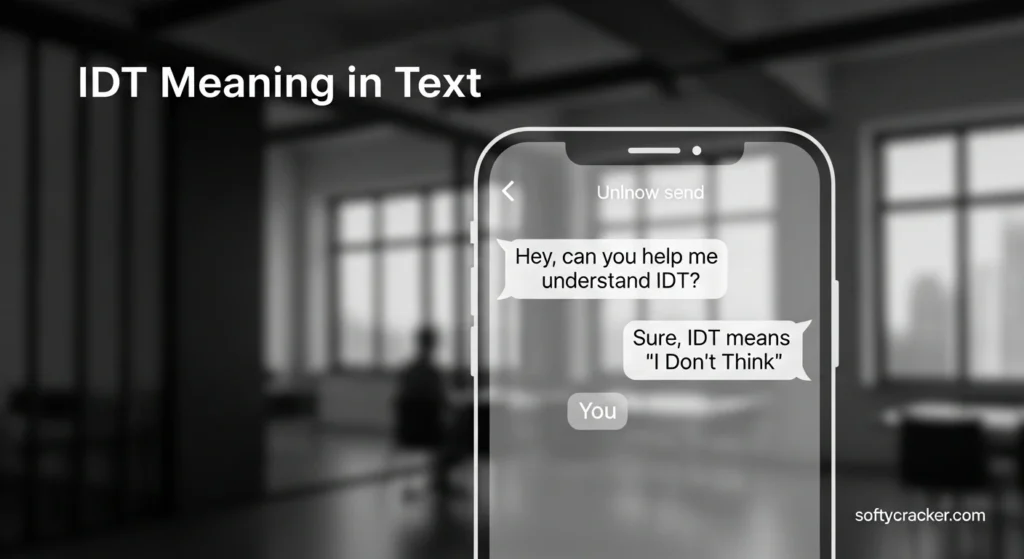
In most online conversations, IDT stands for “I don’t think.” It is a shorthand expression used to communicate doubt, disagreement, or uncertainty in a quick and informal way. Instead of typing the full phrase, people use “idt” to save time and keep conversations flowing naturally.
For example:
- “idt he’s coming today.”
- “idt that’s a good idea.”
- “idt it will rain tomorrow.”
The abbreviation is widely used in texting, social media comments, and messaging apps where speed and brevity matter. It allows users to express hesitation or mild disagreement without sounding too direct or harsh.
However, IDT is not always rigid in meaning. Its tone depends heavily on context. In some cases, it may simply reflect personal opinion rather than strong disagreement. In others, it can signal skepticism or soft rejection of an idea.
What makes IDT interesting is its flexibility. It doesn’t just convey words—it conveys attitude. A simple “I don’t think” becomes softer, faster, and more conversational when reduced to “idt.” This is why it has become a part of modern digital language, especially among younger users who prioritize quick communication.
Origin and Evolution of IDT in Online Slang
Like many internet abbreviations, IDT emerged from the need to type faster during online chats and early texting culture. In the early days of SMS messaging, character limits pushed users to shorten common phrases. “I don’t think” naturally became “idt” as people searched for ways to communicate more efficiently.
As messaging platforms like MSN Messenger, WhatsApp, Snapchat, and Instagram became popular, abbreviations evolved from necessity into cultural habit. IDT survived this transition because it was simple, intuitive, and easy to understand even without explanation.
Over time, IDT became part of a broader digital slang ecosystem where phrases are constantly shortened:
- “idk” = I don’t know
- “imo” = in my opinion
- “brb” = be right back
IDT fits perfectly into this system. Its evolution shows how language adapts to technology rather than the other way around. Instead of writing long sentences, users began compressing thoughts into fragments that still carry meaning.
Today, IDT is not just a shortcut—it’s a cultural marker of online communication style. It reflects how digital natives think, respond, and interact in real time.
Primary Meaning: “I Don’t Think”
At its core, IDT directly translates to “I don’t think.” This phrase is used when someone wants to express doubt or disagreement in a soft, non-confrontational way.
Unlike a firm “no,” IDT leaves room for flexibility. It often reflects personal opinion rather than absolute rejection. This makes it especially useful in conversations where tone matters.
For example:
- “Are you joining the trip?” → “idt I can.”
- “That plan will work.” → “idt so.”
Subtle Strength of the Phrase
The phrase “I don’t think” already carries a mild tone, but when shortened to IDT, it becomes even more casual and less direct. It reduces emotional intensity, making it suitable for friendly or informal exchanges.
Why People Prefer It
People use IDT because it:
- Saves time
- Sounds less harsh
- Fits naturally into fast chats
- Feels conversational rather than formal
This simplicity is what keeps IDT relevant even today, despite the constant evolution of internet slang.
Context-Based Interpretations of IDT
Although IDT usually means “I don’t think,” its interpretation can shift depending on context. Digital language is rarely fixed, and meaning often depends on tone, situation, and relationship between speakers.
In some conversations, IDT may imply:
- Mild disagreement
- Uncertainty
- Soft refusal
- Personal doubt
Example Variations
- “idt it’s worth it” → hesitation about value
- “idt he meant that” → questioning intent
- “idt we should go” → suggesting caution
In each case, the meaning slightly changes based on what follows. This flexibility is what makes IDT both useful and sometimes confusing.
In close friendships, IDT may sound casual and harmless. However, in professional communication, it may appear too informal or vague. Understanding context is essential to interpreting it correctly.
How IDT Is Used in Casual Conversations
IDT thrives in informal digital environments where people communicate quickly and casually. It is especially common in chats between friends, group messages, and social media replies.
Everyday Usage Patterns
People often use IDT:
- To respond quickly without overthinking
- To soften disagreement
- To express hesitation
- To avoid sounding rude
For example:
- Friend 1: “Let’s watch that movie tonight.”
- Friend 2: “idt it’s out yet.”
This usage keeps conversations flowing without unnecessary explanation.
Why It Works So Well
IDT works because it mirrors spoken language. In real life, people rarely say full sentences like “I don’t think that is possible.” Instead, they naturally shorten speech. IDT brings that spoken rhythm into text form.
It acts as a bridge between formal grammar and conversational tone, making digital communication feel more human and less mechanical.
IDT in Social Media Culture
On platforms like Instagram, TikTok, Snapchat, and Twitter (X), communication is fast, reactive, and emotionally driven. IDT fits perfectly into this environment.
Users often use it in:
- Comments
- Replies
- Story responses
- Short debates
For example:
- “idt that trend is coming back.”
- “idt this is accurate.”
Because social media encourages quick reactions, IDT helps users respond instantly without composing full sentences.
Cultural Influence
Social media has also shaped how IDT is perceived. It often appears in humorous, sarcastic, or opinion-based discussions. Over time, it has become part of the “internet voice”—short, direct, and expressive.
In many cases, IDT is not just about disagreement; it becomes a stylistic choice that reflects online personality and tone.
Emotional Tone Behind IDT
Even though IDT is short, it carries emotional depth. It can express hesitation, skepticism, politeness, or even passive disagreement depending on usage.
Common Emotional Layers
- Uncertainty: “idt I’m ready yet.”
- Gentle disagreement: “idt that’s correct.”
- Avoidance of conflict: “idt it’s a good idea.”
The emotional neutrality of IDT makes it versatile. It avoids strong confrontation while still communicating a position.
In digital communication, tone is often harder to interpret than words. IDT helps bridge that gap by softening statements that might otherwise sound too direct.
This emotional flexibility is one of the key reasons it remains widely used in texting culture.
Real-Life Chat Examples of IDT
Understanding IDT becomes easier when seen in real conversations.
Example 1: Plans with Friends
- A: “Movie at 8?”
- B: “idt I can make it.”
Example 2: Opinion Sharing
- A: “This update is amazing.”
- B: “idt it’s that good.”
Example 3: Uncertainty
- A: “Is he coming?”
- B: “idt so.”
These examples show how naturally IDT blends into conversation. It doesn’t interrupt flow or require explanation.
Instead, it acts as a conversational shortcut that keeps interactions smooth and efficient.
Misinterpretations of IDT
Despite being common, IDT is sometimes misunderstood, especially by people unfamiliar with internet slang.
Common Confusions
- Thinking it means something technical or formal
- Misreading it as a typo
- Assuming it has multiple unrelated meanings
In reality, IDT is fairly consistent, but misunderstanding arises due to lack of context.
Another issue is tone misreading. Without vocal cues, “idt” may seem dismissive when it is actually neutral. This is one of the limitations of text-based communication.
Understanding context is key to avoiding misinterpretation.
IDT vs Similar Abbreviations
IDT is often confused with other abbreviations that express thought or opinion.
IDT vs IDK
- IDT: I don’t think (opinion/doubt)
- IDK: I don’t know (lack of information)
IDT vs IMO
- IDT: expresses doubt or disagreement
- IMO: expresses personal opinion
IDT vs NVM
- IDT: hesitation or disagreement
- NVM: “never mind,” used to cancel a thought
Each abbreviation serves a different communication purpose, even if they appear similar.
Understanding these differences helps improve clarity in digital conversations.
When Not to Use IDT
While IDT is useful, it is not always appropriate.
Situations to Avoid
- Formal emails or professional communication
- Academic writing
- Sensitive or serious discussions
In such contexts, IDT may come across as too informal or unclear.
Instead of:
- “idt this strategy works”
It is better to say:
- “I don’t believe this strategy is effective.”
Using full expressions ensures clarity and professionalism where needed.
Psychological Insight: Why People Use IDT
The use of IDT reflects broader psychological patterns in digital communication. Humans naturally seek efficiency, especially in fast-paced environments.
Key Reasons
- Cognitive efficiency: shorter expressions require less effort
- Social softness: reduces confrontation
- Speed of interaction: matches real-time communication
- Group belonging: using slang signals digital fluency
IDT is not just a linguistic shortcut—it reflects how modern communication prioritizes speed and emotional subtlety over formal structure.
It also shows how language evolves to match human behavior in digital environments.
Practical Communication Lessons from IDT
IDT teaches important lessons about how language adapts in the digital age.
Key Takeaways
- Brevity can still carry meaning
- Tone matters as much as words
- Context determines interpretation
- Informal language builds connection
It also highlights the importance of balancing clarity and speed. While abbreviations like IDT are efficient, they are best used in environments where both parties understand the shorthand.
Ultimately, IDT shows how communication is becoming more flexible, adaptive, and emotionally nuanced.
Conclusion
IDT may look like just three small letters, but in digital communication, it carries more weight than it appears. Standing for “I don’t think,” it has become a natural part of texting culture, reflecting doubt, hesitation, and soft disagreement in a fast and efficient way.
Its usage highlights how language evolves with technology, shifting from full sentences to compact expressions that still retain emotional meaning. Whether used in casual chats, social media comments, or quick replies, IDT helps people communicate thoughts without slowing down conversation flow.
Understanding IDT is not just about decoding slang—it’s about understanding how modern communication works. It shows how people balance speed, clarity, and tone in an increasingly digital world. And as online language continues to evolve, abbreviations like IDT will remain small but powerful tools in everyday expression.
FAQs
What does IDT mean in text messages?
IDT usually means “I don’t think,” used to express doubt or disagreement.
Is IDT formal or informal?
It is strictly informal and used in casual conversations only.
Can IDT have different meanings?
In most cases it means “I don’t think,” but context can slightly change its tone.
Is IDT the same as IDK?
No, IDT means “I don’t think,” while IDK means “I don’t know.”
Where is IDT commonly used?
It is commonly used in texting, social media, and online chats.
Is IDT rude to use?
Not usually—it is soft and neutral, but context matters.
Should I use IDT in professional writing?
No, it is better to use full sentences in professional or formal communication.